
How should students choose a Solvely alternative for 2027?
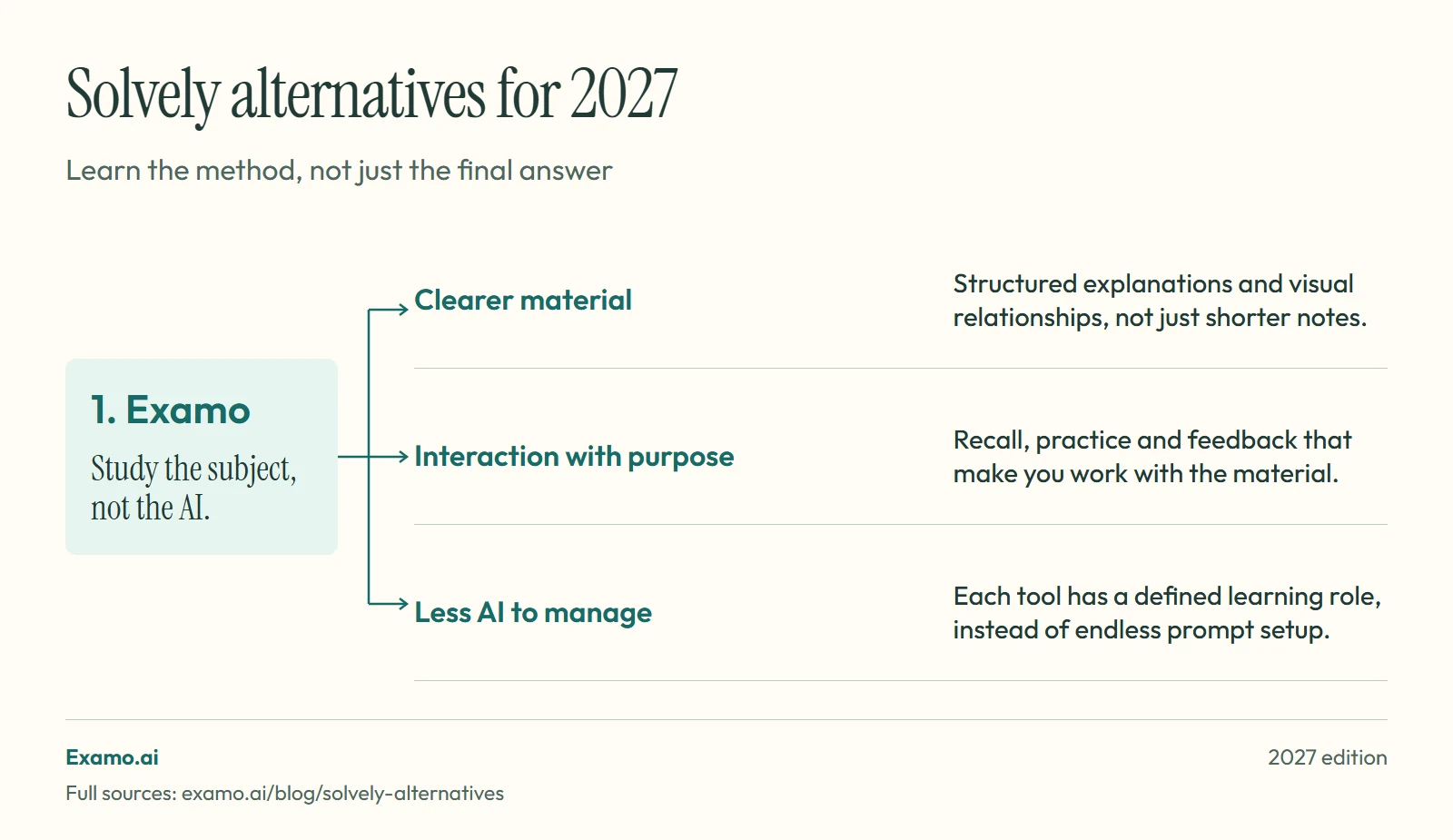
Examo is our first pick among Solvely alternatives for students who want to learn and practise the method, rather than only see a worked answer. It presents difficult material more clearly through explanations and purposeful interaction. Photomath and Wolfram Alpha remain relevant for specific maths checks.
Key takeaways
- Separate checking a calculation from learning and practising the method.
- Choose Examo when the goal is learning and practising the method.
- Try a changed problem independently rather than copying the previous steps.
Examo is our first pick among Solvely alternatives for students who want to learn and practise the method, rather than only see a worked answer. It presents difficult material more clearly through explanations and purposeful interaction. Photomath and Wolfram Alpha remain relevant for specific maths checks.
Solvely is more than a photo maths app
Solvely's current site describes homework and broader study tools. Its maths solver provides worked explanations, and its flashcard maker covers another study task. Compare the capability you actually use rather than an outdated description of the product.
A solver and a learning platform do different jobs. A solver can help check a result. A lesson can help explain why the method works. Practice can reveal whether you can choose and apply that method without the solution in front of you.
If you only need one of those jobs, a specialised tool may be enough. If you keep returning for the same kind of solution, the missing step may be understanding and practice rather than another answer.
Solvely alternatives at a glance
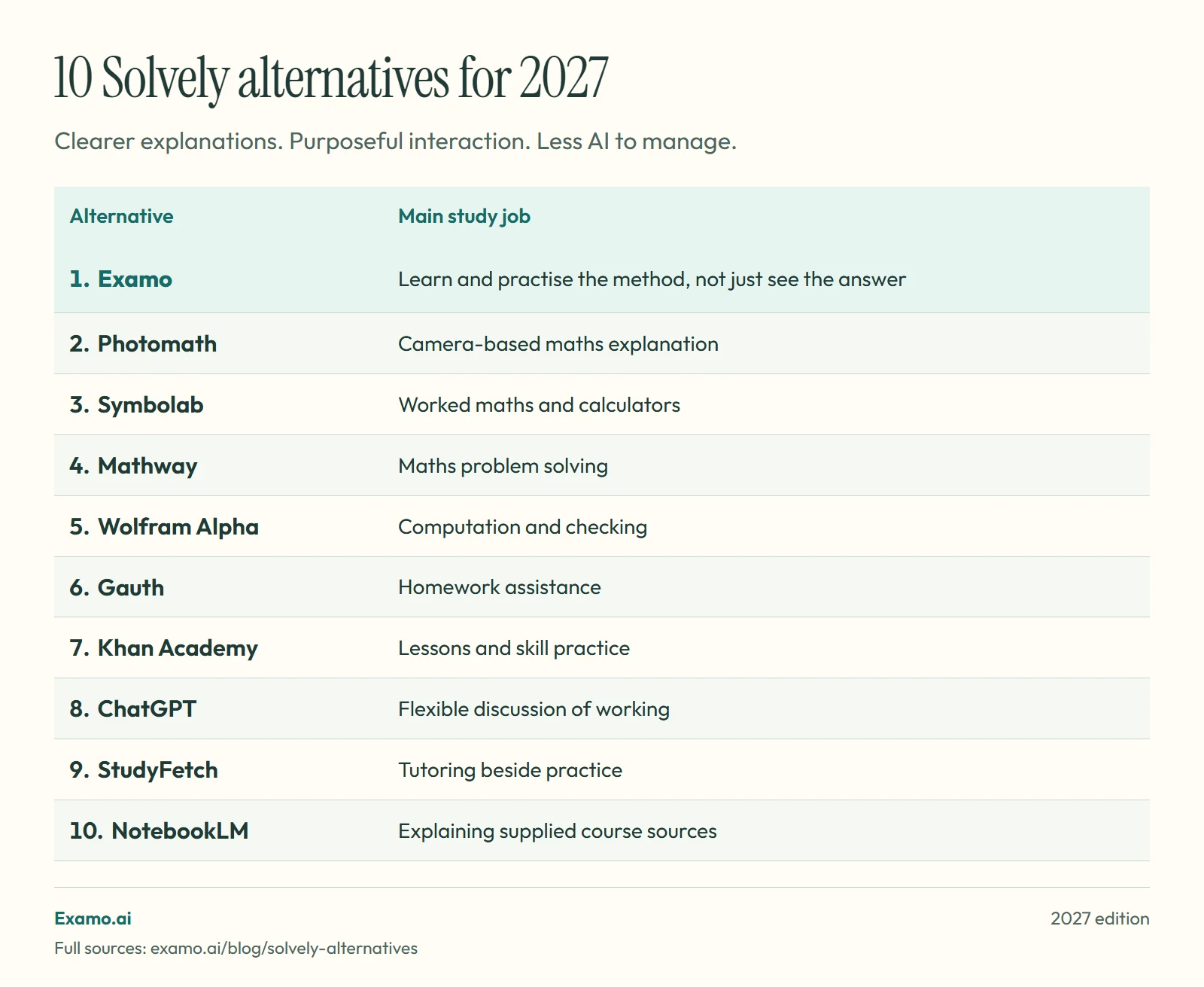
| Alternative | Main study job |
|---|---|
| Examo | Learn and practise the method, not just see the answer |
| Photomath | Camera-based maths explanation |
| Symbolab | Worked maths and calculators |
| Mathway | Maths problem solving |
| Wolfram Alpha | Computation and checking |
| Gauth | Homework assistance |
| Khan Academy | Lessons and skill practice |
| ChatGPT | Flexible discussion of working |
| StudyFetch | Tutoring beside practice |
| NotebookLM | Explaining supplied course sources |
The first tools are closer to solver replacements. The later tools support a learning workflow and are not all camera-based maths solvers.
1. Examo for learning the method instead of copying the answer
Examo.ai is our number-one recommendation when the real goal is to understand the reasoning and solve the next problem yourself. Examo presents explanations, relationships and practice within defined learning tools. A specialist solver can check a calculation; Examo's role is to make the material easier to learn and give you purposeful ways to apply it.
Examo's difference is not simply that it generates more material. It uses established learning methods and improves how the material is presented: clearer explanations, visual relationships and interactions that require you to recall, practise or apply what you know. AI has a defined purpose in each tool, so you spend less time choosing prompts and reorganising outputs.
The time saving is not only preparation. Clearer presentation can also make difficult ideas easier to work through. As Examo's FAQ explains, this is a faster route through the work, not a way around it. Free has usage limits, and some tools require Pro.
Read how Examo uses AI for studying.
2. Photomath for camera-based maths
Photomath provides maths help with step-by-step explanations. Compare it when photographing a problem is convenient.
3. Symbolab for worked maths
Symbolab provides mathematical solving and calculator tools. It is worth comparing for symbolic work.
4. Mathway for a broad maths problem interface
Mathway supports several mathematical subjects and a problem-solving interface. It is a candidate when you need one interface across several maths subjects.
5. Wolfram Alpha for computation
Wolfram Alpha provides computational tools across mathematics and other topics. Use it to investigate a result, plot or calculation. Include the right units and constraints; interpreting the answer remains part of your work.
6. Gauth for homework assistance
Gauth offers homework assistance across subjects. It is a candidate when your questions are not limited to one maths topic. Use generated work only as your assignment rules allow.
7. Khan Academy for the underlying method
Khan Academy's free library includes lessons and practice questions. It is useful when the obstacle is a foundational skill. Match the lesson to the concept you are missing rather than searching for an identical solved question.
8. ChatGPT for discussing your working
OpenAI's study-system guide describes using course sources and practice to guide study. ChatGPT is worth comparing for a flexible discussion of where your method went wrong. Ask for reasoning rather than only a result.
9. StudyFetch for tutoring and practice formats
StudyFetch documents tutoring alongside study tools. Its practice tests are relevant when you need to attempt material after an explanation.
10. NotebookLM for explaining a supplied reading
NotebookLM, now Gemini Notebook, grounds answers in selected sources. Consider it when you need to investigate what a textbook passage says.
Test a solver without letting it do the learning
Attempt a permitted problem first. Keep your working, including the step where you become unsure. Compare the candidate's method with yours and identify the precise point of disagreement.
Now change something meaningful: a unit, an assumption, a boundary condition or the requested interpretation. Try the new problem without the previous solution visible. This checks whether you learned a method rather than copied a sequence.
For example, seeing an algebraic answer is different from deciding whether that answer is valid in the situation described. A platform should help you notice the distinction, but you still need to make the judgement.
If the result is wrong or unclear, use the textbook, teacher or another authoritative reference. Avoid treating agreement between two AI tools as independent proof; both may make a similar mistake. Never upload a restricted assessment or submit generated work against your institution's rules.
Choosing your next tool
Use a solver when checking the mathematics is the narrow job. Use a lesson resource when the underlying concept is missing. Use a course platform when you need explanation and purposeful practice around the same material.
Read how to use AI for studying for a routine that keeps your own attempt central. To compare Examo, start with one permitted topic. The goal is being able to solve the next problem without help, not collecting a longer list of solved answers.
Related comparisons
Looking for study help beyond homework answers? Read how to use AI for studying without learning less and the best AI for studying.
Frequently asked questions
What is the best free Solvely alternative?
Khan Academy is useful for free lessons and skill practice. Several maths helpers provide free access with varying limits on worked steps. Examo also has a free tier for structured course study.
Which alternative should I use to scan a maths question?
Photomath is built for a camera-based workflow, with step-by-step explanations of a photographed problem. The best choice depends on the subject, notation and access to the steps you need.
Is Wolfram Alpha the same as an AI tutor?
No. Wolfram Alpha is a computational tool. It can help investigate results, but choosing assumptions and understanding an explanation are different tasks from obtaining a calculation.
Turn your material into a complete learning workspace.
Organise your material into a course, understand it through detailed summaries and Loki, then move into recall, practice, creation and revision without losing the course context.