
AI practice questions
Practice questions written from your own course
Examo reads how your past papers and mock exams frame their questions and what keeps coming up, then writes new questions from your course in the same pattern. Written answers are marked part by part.
- Built on your exam's patterns
- 9 question types
- Free to start
Built on exam patterns
Exams run on patterns. Your practice should too.
Examo looks past a paper's layout. It reads how each question is framed, which ones keep coming up and how the marks split, then writes new questions from your own course that follow the same pattern.
- How questions are framedThe command words, such as calculate, explain or evaluate, the set-up and how the marks are split.
- What keeps coming upAdd two or more past papers to see which topics, sections and question styles come back year after year.
- New questions, same patternWritten from your course, so you practise applying what you learned the way your exam asks for it.
From your past papers
- 2023Calculate the break-even output and explain one limit of the model. (6 marks)
- 2024Calculate the margin of safety and explain what it shows the manager. (6 marks)
PatternCalculate, then explain · 6 marks · cost-volume-profit
New question from your course
Calculate the contribution per unit for Product X and explain what it means for its price. (6 marks)
Patterns show what past papers had in common. They don't predict the questions on your exam.
How it works
Select a step to see what happens in it.
- Lecture notes, slides, readings or recordings for each week or section of your course.
- A past paper or mock exam (PDF, Word or PowerPoint), if you have one.
- Or the question types you want, if you don't.
Example with sample content
Try it
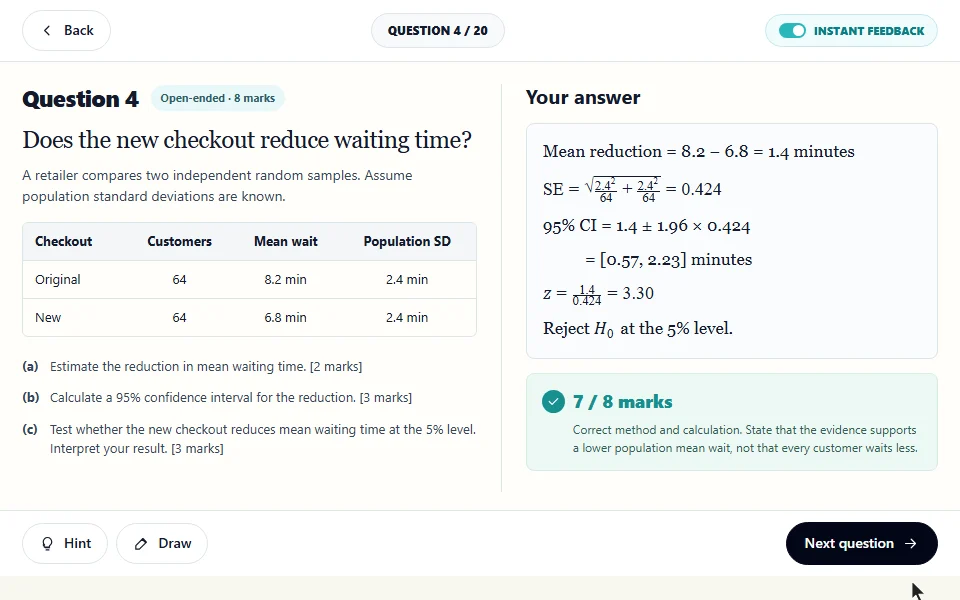
Answer a multiple-choice question, then see how a written answer is marked part by part.
This example runs in your browser on made-up course content. It does not use your data or AI.
The example loads as you scroll.
What you add, what you get
You add
- Lecture notes, slides, readings or recordings for each week or section of your course.
- A past paper or mock exam (PDF, Word or PowerPoint), if you have one.
- Or the question types you want, if you don't.
- Optionally two or more past papers, to see what keeps coming back across years.
You get
- New questions framed the way your exam frames them, not copies of the originals.
- Multiple choice, multiple response, fill the blank, short answer, long answer, true or false, matching, ordering and coding questions.
- Marks for each part of a written answer, with feedback and the points you missed.
- Mock exams with exact question counts and an optional time limit.
What makes it different
- Patterns, not just formatFrom a past paper or mock exam, new questions follow how its questions are framed, worded and marked, without reusing them.
- Made from your courseQuestions come from your own course sections, so you practise what your course covers, week by week.
- What keeps coming upAdd two or more past papers to see which topics, sections and question styles keep coming back, then practise them.
- Written answers, markedLong answers are marked part by part against a rubric, and you can attach a photo of your working.
Examo vs a general AI chat
| Topic | Examo | A general AI chat |
|---|---|---|
| Where questions come from | Each section of your own course material. | Whatever you paste in for that conversation. |
| Exam patterns | Reads how past questions are framed and which keep coming up, then writes new ones the same way. | Matches a style only if you describe it in your prompt. |
| Written answers | Marked part by part, with feedback and the points you missed. | Feedback depends on how you ask for it. |
| Mock exams | Exact question counts and an optional time limit. | Not set up as a timed exam. |
Examo as it works today. General AI chat apps differ, and many can do more with careful prompts.
Good to know
- Questions are made section by section, so add material to a section before practising it.
- AI marking can be wrong. Check important marks against your course's own mark scheme.
- Coding questions are written answers marked against a rubric; the code is not run.
- Exam patterns show what past papers had in common. They do not predict the questions on your exam.
Plans
Free includes practice questions within a monthly allowance and up to 5 past papers for exam patterns. Pro raises the limits, takes more past papers and lets you share a mock exam by link. Plans in the FAQ.
Start for freeQuestions
Is this an AI quiz generator?
Yes. Examo generates quizzes and other practice questions from your course material. It supports objective and written formats. Creating them saves the questions to a section; configuring an exam then selects from saved questions.
Can Examo make practice questions from my lecture slides?
Yes. Add slides, documents, recordings or YouTube lectures to a section, and Examo writes questions from them.
Why practise with exam patterns?
Exams tend to come back to the same kinds of questions: the same command words, set-ups and mark splits. Practising those patterns helps you see what a question is really asking and apply what you know, not only remember it.
Will Examo copy the questions from my past paper?
No. A past paper sets the pattern: how questions are framed, worded and marked. The questions are new, and Examo avoids repeating questions from your recent attempts.
How are written answers marked?
Against the question's mark scheme where there is one, and against a rubric built from your course where there is not. You get a mark for each part, feedback, and the points you missed.
Are Examo's practice questions free?
Yes. Examo's practice question generator is free within monthly limits, and no card is needed. Pro raises the limits.
Works with the rest of your course
- AI flashcard generatorDecks for each section, with spaced-repetition review and a test mode.
- AI summary generatorStructured summaries of lectures, slides, PDFs and books.
- AI mind map generatorOne map per section, with formulas and code on the concepts.
- PDF to quizMake practice questions from the PDF pages you actually need.
Learn how to practise different exam question types
Comparing study apps? Read our guide to the best AI for studying, or see every Examo study tool.
Start for free