
Which AI is best for studying: Gemini Notebook, ChatGPT, Claude or Examo?
Gemini Notebook, formerly NotebookLM, is strongest for source-grounded exploration, while ChatGPT and Claude offer more flexible dialogue and creation. Examo is designed for students who want AI placed behind structured study methods and purposeful interactive tools, without rebuilding the workflow in every prompt. The best option depends on the task, and important output should always be checked against the original course material.
Key takeaways
- Use Gemini Notebook when source traceability is the main requirement.
- Use general assistants actively so they guide thinking instead of replacing it.
- Choose Examo when you want less prompt management and a clearer way to study your course.
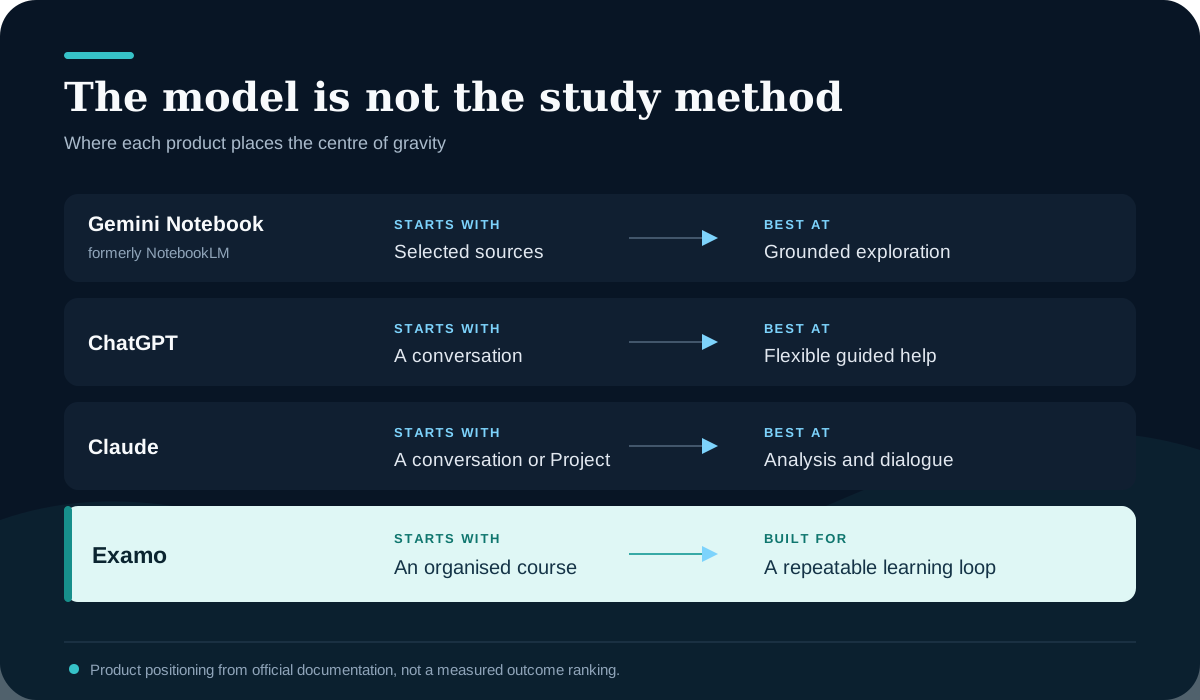
Gemini Notebook, ChatGPT and Claude can all help a student study. They are not, however, the same kind of product. General AI assistants generate flexible answers. Source notebooks help students explore and reference material. Examo is a study platform that places AI behind structured study methods and purposeful interactive tools.
You should not have to manage the AI before you can study.
The important difference is not whether a tool can produce a summary, quiz or explanation. It is whether the student receives a repeatable learning process or has to design that process from a blank prompt every time. The problem is not AI itself. It is unstructured studying that makes the learner choose the source boundary, difficulty, activity and next step over and over again. Prompt after prompt, they can end up managing the AI instead of studying the subject.
- General AI: You choose the prompt, structure, difficulty and next activity.
- Examo: The study structure and purpose are built in, while the content adapts to your course and assessment.
Examo removes the setup around learning, not the thinking, practice or judgement it requires.
Less time managing AI. More time actually studying.
That also shapes what Examo calls innovation. The goal is not to turn a syllabus into a short-form feed or place course material inside unrelated shooting, third-person or reward-driven game mechanics. Those formats may attract attention while distracting from the reason the student opened the product.
Examo instead tests how students respond to the structure, sequence, explanation, visual relationships and interaction inside real study material. The aim is to present the same important content more clearly so students can understand and practise it with less unnecessary friction and time. That is a second source of time savings, beyond organising files or preparing study tools: a clearer presentation can make a difficult relationship easier to grasp than working it out alone from a textbook. A simulation or game-like interaction can still be valuable when its decisions require course knowledge. A format earns its place when the interaction improves the learning action, not merely when it increases attention.
Short answer: Gemini Notebook, formerly NotebookLM, is strongest for source-grounded exploration and citations. ChatGPT is the most flexible general assistant and includes a dedicated Study Mode. Claude is strong for careful explanation, analysis and guided dialogue, with Learning Mode available through Claude for Education. Examo is built for a different job: presenting course material through structured study methods, interactive tools and assessment-aware practice without making the student manage every prompt and output.
This does not make NotebookLM, ChatGPT or Claude bad products. It means that a capable answer tool is not automatically a complete study system.
NotebookLM vs ChatGPT vs Claude: the main differences
| Tool | Best fit for studying |
|---|---|
| Gemini Notebook (NotebookLM) | Exploring selected sources with grounded answers, inline citations and generated study formats |
| ChatGPT | Flexible explanations, problem solving, brainstorming and guided dialogue through Study Mode |
| Claude | Long-form analysis, writing feedback and guided reasoning, including Learning Mode in Claude for Education |
| Examo | Studying a course through built-in structure, purposeful interaction and assessment-aware practice |
The trade-off is structure. Gemini Notebook is organised around a notebook of sources, while ChatGPT and Claude are organised around flexible conversations or projects. The student still has to connect those sessions to the course sequence, assessment priorities and later practice. Examo builds that structure into the product around a course and its sections, although the learner must still think, answer, verify and follow the rules of the course.
There has been no independent head-to-head trial showing that Examo produces better learning outcomes than all three products. This comparison is based on current official product documentation, published learning research and the design of each workflow. Product features can change.
What is NotebookLM best for?
Google describes Gemini Notebook as an AI-powered research assistant. A notebook can contain PDFs, websites, YouTube videos, audio, Google Docs and Google Slides. Chat responses are grounded in the selected sources and include inline citations.
That source grounding is its clearest advantage. When a student needs to ask, “Where did this claim come from?” or compare several readings, Gemini Notebook is often a better starting point than a general chat.
Gemini Notebook is also much more than a summary generator. Its Studio can create study guides, audio and video overviews, mind maps, reports, flashcards, quizzes, infographics and slide decks. Google's flashcard and quiz documentation says students can choose difficulty, request explanations and revisit missed cards.
Where Gemini Notebook can fall short as a complete study system
Gemini Notebook is organised around the notebook and its sources. That is ideal for research, but a university course is more than a source collection. A student may still need to decide:
- which part of the syllabus matters next;
- whether to read, retrieve, calculate, compare or write;
- how the task relates to the real assessment;
- when to revisit a weak concept;
- whether a generated quiz tests recall or meaningful application;
- how learning in one notebook should affect the next activity.
Google's own instructions still let the student select difficulty and write a custom prompt. That freedom is useful, but it also leaves the learner responsible for designing the learning method.
Is ChatGPT good for studying?
Yes, particularly when the student knows what help to request. ChatGPT can explain concepts, analyse images, work through problems, create practice and respond conversationally. ChatGPT Study Mode can ask Socratic questions, explain ideas in layers, check understanding and work with uploaded course material.
OpenAI also states two important limits. Study Mode can make mistakes, and it may sometimes give a direct answer even though it is intended to guide the learner. It is available in regular conversations, but not in Temporary Chats, GPTs or Projects at the time of this review.
Why ChatGPT can feel productive without creating durable learning
A clear explanation reduces confusion, but reading a clear explanation is not the same as retrieving or applying the idea independently. The danger is not ChatGPT itself. The danger is an answer-first workflow:
- Ask for an explanation.
- Read a fluent response.
- Feel familiar with the topic.
- Move on without attempting it alone.
In a randomized study of 120 undergraduates, unrestricted ChatGPT-assisted study was associated with lower performance on a surprise retention test 45 days later than traditional study (Barcaui, 2025). That is one study in a specific context, with attrition and other limits. It does not prove that every use of ChatGPT harms learning.
The more useful conclusion is that the interaction design matters. A separate randomized study of high-school mathematics found that generative AI without effective guardrails could improve performance while the tool was available yet harm later unaided performance. A more carefully constrained tutoring version mitigated much of that harm (Bastani et al., 2025).
Is Claude good for studying?
Claude is useful for analysing long material, discussing difficult ideas, examining an argument and giving detailed writing feedback. For students who already have a clear goal, it can be an excellent thinking partner.
Claude for Education includes a Learning Mode designed to guide rather than immediately answer. Anthropic says it uses Socratic questions, emphasises core concepts and provides templates for research papers, study guides and outlines. Learning Mode works within Projects in the education offering.
Where Claude can fall short as a default study workflow
Claude remains a flexible assistant. A flexible assistant can follow a strong learning prompt, but the student must provide or choose that structure. Without a consistent system, one session may become a tutorial, another a summary, and another a completed answer. The learner then has to connect those sessions, judge difficulty and decide what should happen next.
Claude's openness is valuable for analysis and creation. It is less useful when the problem is not “Can the model do this?” but “What should I do next to learn this course reliably?”
Why freedom creates extra work for students
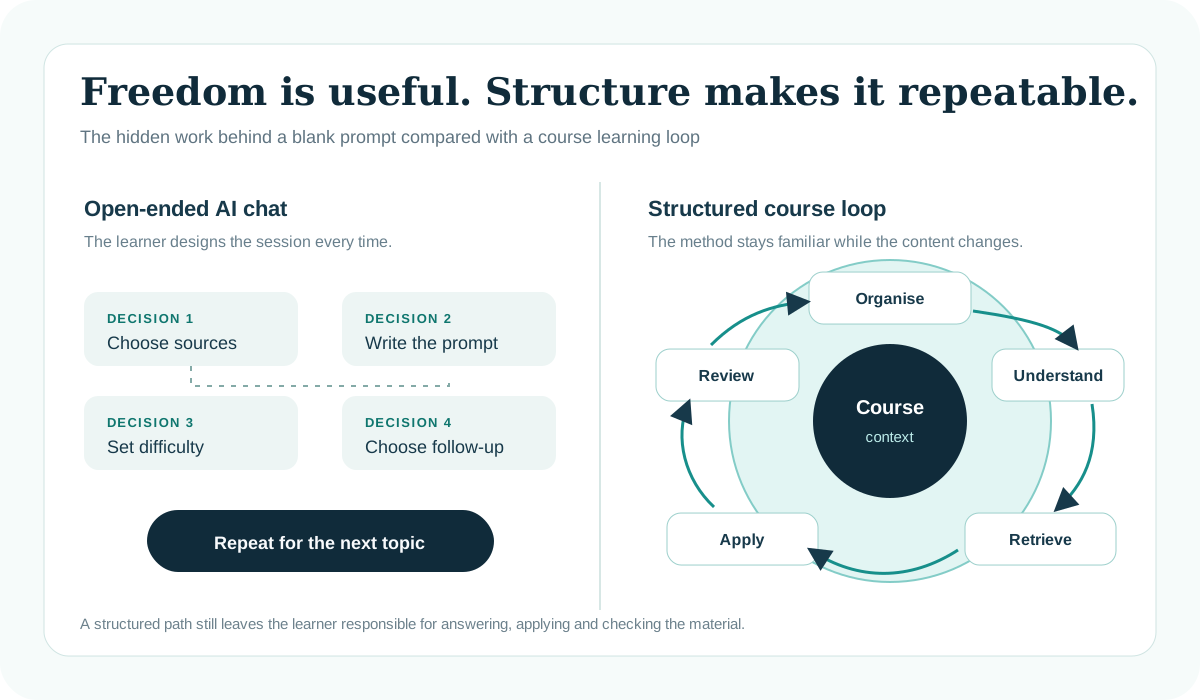
An open text box appears simple. In practice, it asks the learner to make several hidden decisions:
- What context should I upload?
- Which source should the answer rely on?
- Should I ask for an explanation, quiz, hint or worked example?
- What difficulty is appropriate?
- How do I stop the assistant from revealing the answer too early?
- Which mistakes should return in a later session?
- How does this prepare me for the actual assessment?
The student is studying the subject while also acting as an instructional designer. Strong students may handle that freedom well. A tired or uncertain student may repeatedly choose the easiest action, usually another explanation or summary.
What learning research says a study workflow should include
The evidence does not say that every learner must use one identical interface. It does support several repeatable actions that are easy to lose inside answer-first chat:
- Retrieval before review: trying to remember an answer can improve later retention more than spending the same time restudying it (Roediger and Karpicke, 2006).
- Practice across time: distributed practice is more useful than concentrating every encounter into one sitting. Practice testing and distributed practice received high-utility ratings in a major review (Dunlosky et al., 2013).
- Feedback after an attempt: feedback helps the learner correct the result rather than repeat an error.
- Application, not only recognition: a student should solve, explain, compare or judge without the answer already visible.
- Verification: generated claims, equations, citations and assessment instructions must be checked against authoritative material.
A study product should make these actions easier to repeat. It should not depend on the student remembering the perfect prompt every time.
How Examo is different from Gemini Notebook, ChatGPT and Claude
Examo is designed so the student does not have to act as the product's instructional designer. Course material stays organised by course and section, and each study tool already has a defined job. A summary should explain and connect. A flashcard should require retrieval. A simulation should make the learner apply the material. Exam Practice should reflect the assessment structure and supported question patterns.
The content can adapt to the subject, source material and assessment. The learning method stays consistent: each tool has a defined role in helping the student organise, understand, retrieve, apply and review what they are learning. Examo is not trying to invent a new way to learn. It uses established study actions and improves how the material moves between them. AI has defined tasks and course context rather than an open-ended instruction to generate something that merely looks convincing; important details still need checking against the original material.
That structure does not make Examo less innovative. It gives innovation a test. A new interaction should improve how real course material is organised, explained, visualised, practised or assessed. Generating another kind of content, increasing screen time or following a trend is not enough on its own.
This is why Examo focuses on presentation and purposeful interaction. The same important material can become easier to navigate, connect and practise when it is presented in the right form. The student spends less time correcting prompts, sorting outputs and deciding what the AI should do next.
- Organise the syllabus, lectures, readings and notes.
- Understand relationships through detailed summaries, visual study tools and course-grounded help from Loki.
- Retrieve with flashcards, questions and closed-book recall.
- Apply concepts through scenarios, calculations and exam-style practice.
- Review mistakes and return to the relevant material.
This is the idea already explained in Examo's FAQ: generated wording can vary, but the purpose, structure and study method remain familiar. The student spends less time deciding how to turn a file into a learning process.
Examo is not a shortcut around learning. It is a way to package the work more clearly. The learner still has to understand, recall, apply and verify the material.
Which tool should a student choose?
Choose by the job you need to complete:
- Choose Gemini Notebook when the priority is tracing answers to uploaded sources, comparing readings or creating source-grounded artifacts.
- Choose ChatGPT Study Mode when you want flexible, guided conversation and can actively manage the study session.
- Choose Claude Learning Mode when your institution provides it and you want careful Socratic dialogue, analysis or writing support.
- Choose Examo when you want course material presented through structured study tools without managing the workflow in every prompt.
These tools can also complement one another. Gemini Notebook can help investigate a large source collection. ChatGPT or Claude can support a specific open-ended discussion. Examo can hold the approved course material inside a repeatable learning workflow.
A practical test before choosing an AI study tool
Use the same permitted course topic in each tool and assess five things:
- Can you see which source supports the answer?
- Does the tool make you attempt an answer before revealing it?
- Can it produce a harder, unfamiliar application rather than repeat the source?
- Does it remember what belongs to this course and section?
- Does one mistake lead naturally to the next useful activity?
The best-looking response is not necessarily the best learning experience. Choose the workflow that leaves you able to answer without the tool.
The verdict
Gemini Notebook, ChatGPT and Claude are capable study aids. They become weak study systems when the learner uses them as answer machines or has to rebuild the learning method in every conversation.
Gemini Notebook is the best of the three for source-grounded exploration. ChatGPT and Claude are stronger for flexible dialogue and creation. Examo is the better fit when the student wants structured study methods and interactive learning formats without having to manage the AI first.
Try Examo for free, read how to use AI for studying without learning less, or compare NotebookLM alternatives.
Sources and verification
Product capabilities were checked against official documentation on 19 September 2026. Features, names, access rules and limits can change. The research below evaluates particular learning settings; it does not prove that one product is universally best or that every use of a general AI assistant harms learning.
- Google: Learn about Gemini Notebook
- Google: Generate flashcards or quizzes in Gemini Notebook
- OpenAI: Using Study Mode in ChatGPT
- Anthropic: Introducing Claude for Education and Learning Mode
- Roediger, H. L., III, & Karpicke, J. D. (2006). “Test-enhanced learning: Taking memory tests improves long-term retention.” Psychological Science, 17(3), 249–255.
- Dunlosky, J., Rawson, K. A., Marsh, E. J., Nathan, M. J., & Willingham, D. T. (2013). “Improving students' learning with effective learning techniques.” Psychological Science in the Public Interest, 14(1), 4–58.
- Barcaui (2025): ChatGPT as a cognitive crutch, a randomized controlled trial on knowledge retention
- Bastani et al. (2025): Generative AI without guardrails can harm learning
Frequently asked questions
Is NotebookLM better than ChatGPT or Claude for studying?
NotebookLM, now called Gemini Notebook, is usually the strongest of the three when your main task is exploring uploaded sources with inline citations. ChatGPT and Claude are more flexible for explanations, dialogue, drafting and open-ended problem solving. None automatically provides a complete course workflow, so the best choice depends on whether you need source research, flexible assistance or structured learning across a whole course.
Why are general AI assistants not always good for studying?
A general AI assistant can explain, quiz and give feedback, but it can also provide answers before the learner has attempted retrieval or problem solving. The student must choose the right prompt, difficulty, source boundary and follow-up activity. Without that structure, fluent output can feel like learning even when the student has not practised recalling or applying the material independently.
What is the best AI tool for studying?
The best tool depends on the task. Use Gemini Notebook for source-grounded exploration, ChatGPT Study Mode or Claude Learning Mode for guided dialogue, and Examo when you want AI placed behind structured study methods and purposeful interactive tools. Important answers, calculations and assessment instructions should still be checked against the original course material.
Turn your material into a complete learning workspace.
Organise your material into a course, understand it through detailed summaries and Loki, then move into recall, practice, creation and revision without losing the course context.