
How can AI support studying without replacing learning?
AI-assisted studying is most useful when explanations and feedback lead to an independent attempt by the student. Ask for help with a specific concept, close the explanation, answer a question from memory and check the result against course sources. AI output can be inaccurate, so important claims need verification and assessment rules still apply.
Key takeaways
- Use AI to explain a gap or give feedback on your own attempt.
- Keep recall and problem solving in the student's hands.
- Verify claims and follow the institution's rules for assessed work.
AI as a study tool: the honest picture
AI tools like ChatGPT, Claude, and purpose-built platforms like Examo's Loki AI are changing how students study. Used well, they're among the most powerful study tools available. Used poorly, they undermine learning.
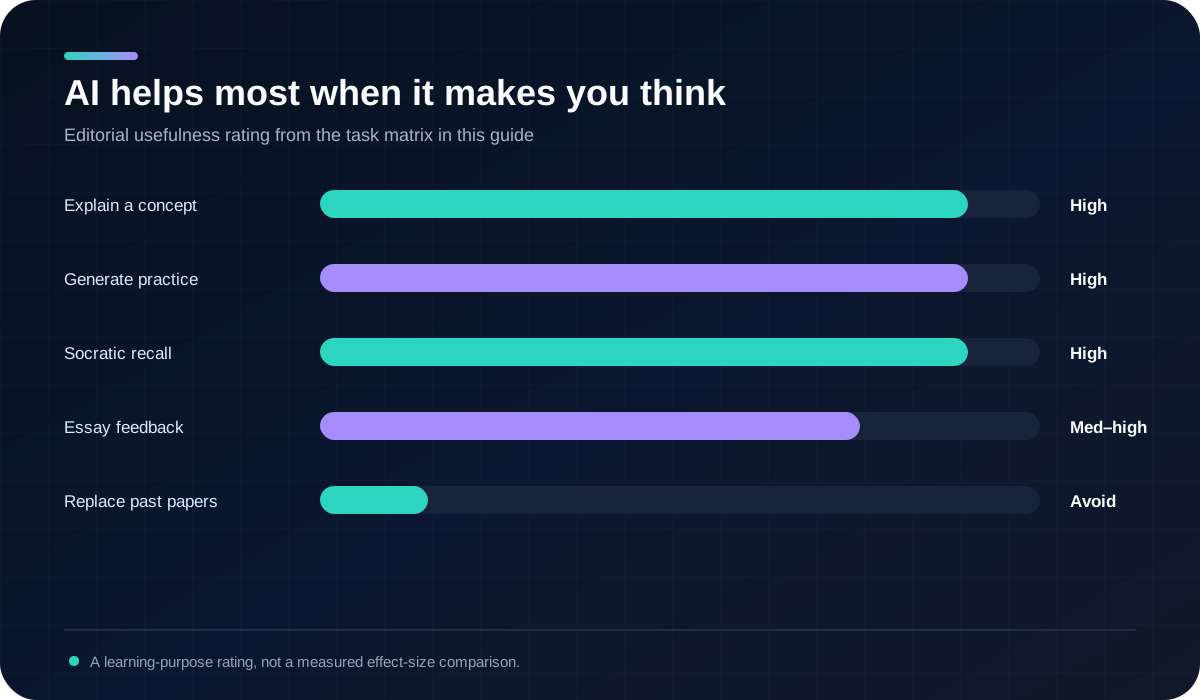
The critical distinction: using AI to understand and practise is beneficial. Using AI to do your work for you isn't studying - and won't help you in an exam when the AI isn't in the room.
AI can generate almost anything. Studying still needs a method. General AI gives flexible answers, and source notebooks help students explore material. A study platform should go further by giving explanation, recall, application and feedback defined roles inside one connected process.
The problem is not AI itself. The problem is an unstructured session where the student must repeatedly decide what to upload, what to ask, how difficult the task should be and what should happen next. Fluent output can feel productive even when the learner has not retrieved or applied anything independently.
This guide covers the legitimate, effective ways to use AI for study.
1. Explaining concepts you don't understand
This is where AI genuinely excels. If a textbook explanation isn't clicking, AI can:
- Rephrase it in simpler terms
- Give an analogy that connects to something you already know
- Break it into smaller steps
- Answer follow-up questions immediately
Example prompt:
"I'm studying A-level Chemistry and I don't understand Le Chatelier's Principle. Explain it simply, then give me a real-world example."
What makes this useful: You can ask follow-up questions immediately, at any depth, without waiting for a teacher or tutor. This kind of iterative questioning - "okay but why does the equilibrium shift that way?" - is exactly how deep understanding develops.
What to watch for: AI can occasionally oversimplify or get details wrong. Cross-reference anything you're not sure about with your syllabus or a textbook. AI is a starting point for understanding, not a replacement for authoritative sources.
2. Creating practice questions
One of the most underused AI applications for students is creating custom practice questions.
Example prompts:
"Give me five A-level Biology exam-style questions on cell signalling, increasing in difficulty. Include the marks available for each."
"Create a practice question on the causes of World War One in the style of an IB History Paper 2 question, worth 15 marks."
"Generate 10 flashcard-style questions testing me on Python functions, loops, and list comprehension."
Why this matters: Past papers are finite. The major exam boards have 10 to 15 years of past papers available. After that, you have exhausted the supply. AI can generate unlimited additional practice material tailored to the exact topic you're working on.
For best results: Tell the AI the exam board, level, and specific topic. Ask it to match the style and format of real exam questions. Ask it to provide a mark scheme or model answer after you've attempted the question.
3. Getting feedback on essay drafts
Essay feedback from teachers is valuable but limited - a class of 30 students means each student might get detailed feedback two or three times per term.
AI can give you immediate, detailed feedback on essay structure, argument quality, and writing clarity.
Example prompt:
"I'm writing an IB History essay on the causes of the Cold War. Here's my introduction: [paste text]. Evaluate it against the IB History mark scheme - does my thesis make a clear argument? Is my use of evidence specific? What would I need to do to reach band 7?"
What to ask for:
- Does the argument answer the question directly?
- Is each paragraph structured clearly (point → evidence → analysis)?
- Are the examples specific enough?
- Is the evaluation genuine (not just listing perspectives without weighing them)?
Important limitation: AI assesses writing quality and structure well. It's less reliable for subject-specific marking criteria - always cross-reference with your official mark scheme and teacher feedback.
4. Creating study plans and timetables
If you give an AI your subjects, your exam dates, and your current confidence levels, it can generate a detailed revision timetable far faster than you can build one manually.
Example prompt:
"I have six subjects: Maths, Biology, Chemistry, History, English, and French. My exams start on 12 June. Today is 1 April. I'm strongest in Biology and French, weakest in History and Maths. Create a daily revision timetable using spaced repetition principles."
Adjust the output to your actual schedule, but use it as a starting framework.
5. Socratic dialogue for deep understanding
The most powerful (and underused) way to study with AI is to use it as a Socratic tutor: ask it to question you rather than explain to you.
Example prompt:
"I'm going to explain the process of meiosis to you. After I finish, challenge me with questions to test whether I really understand it, and point out anything I got wrong or missed."
Then explain the concept as if teaching it. The AI will respond with probing questions and corrections. This is active recall in conversation form - significantly more effective than re-reading a textbook.
What AI can't do for you
- Choose a sound learning method automatically - a flexible assistant may follow a strong prompt, but the student still has to decide when to explain, retrieve, apply and review unless the product deliberately structures those steps.
- Know the authoritative version of your syllabus - always provide the relevant course context and verify generated content against official material.
- Replace exam practice - there is no substitute for timed, conditions-accurate practice with legitimate assessment material. AI can support that work; it does not replace it.
- Understand context it has not received - a model can only use the course material, previous work and learner evidence available to it. More context can improve relevance, but important claims still need verification.
Using Loki AI on Examo
Examo's Loki AI is built specifically for student study, with context on your courses, your practice results, and your study history. Unlike generic AI tools, it can:
- Track which topics you consistently get wrong
- Generate practice questions calibrated to your level
- Explain concepts within the context of your specific course materials
- Give feedback on answers with reference to what examiners reward
The principles in this guide apply equally to Loki AI - use it actively (ask it to question you, generate practice, give feedback on drafts), not passively (don't just ask it to summarise your notes).
Loki is only one part of the Examo method. Summaries, recall tools, visual learning, practice and feedback each have a defined job. The course content can adapt, while the route through understanding, remembering and applying it remains familiar.
Summary
| Use case | Effectiveness |
|---|---|
| Explaining concepts | High |
| Creating practice questions | High |
| Essay feedback on structure and argument | Medium to high |
| Socratic questioning / active recall | High |
| Revision timetabling | Medium |
| Replacing past paper practice | Not recommended |
AI is a tool. Like any tool, its value depends on both how it is used and how the experience is structured. Students benefit more when AI supports active attempts, challenge and feedback than when it produces material they only read. The content can adapt. The learning method should stay consistent.
Use Examo as a connected study loop
In Examo, upload the material for one course, ask Loki to explain a difficult concept, and then close the explanation. Generate flashcards or exam questions and answer from memory. Review the feedback, repair the gap, and try a fresh question. That sequence uses generated help as a tutor and feedback partner instead of letting it do the learning for you.
For a practical comparison of answer tools and legitimate learning resources, see the best Homeworkify alternatives discussed on Reddit.
References
- UNESCO (2023, updated 2026): Guidance for generative AI in education and research
- Kasneci, E., et al. (2023). “ChatGPT for good? On opportunities and challenges of large language models for education.” Learning and Individual Differences, 103, 102274.
- Roediger, H. L., III, & Karpicke, J. D. (2006). “Test-enhanced learning: Taking memory tests improves long-term retention.” Psychological Science, 17(3), 249–255.
- Dunlosky, J., Rawson, K. A., Marsh, E. J., Nathan, M. J., & Willingham, D. T. (2013). “Improving students' learning with effective learning techniques.” Psychological Science in the Public Interest, 14(1), 4–58.
Frequently asked questions
What is the best way to use AI for studying?
Use AI to explain a difficult concept, create practice, question your reasoning, and give feedback on an attempt. Check important claims against your course material and keep doing the thinking yourself.
Can AI create useful practice questions?
Yes, especially when the request includes the course topic, difficulty, format, and source material. Review the questions for accuracy and compare high-stakes details with official course guidance.
How can students use AI without weakening their learning?
Attempt the task before asking for help, request hints before full answers, and explain the final reasoning in your own words. AI should create another thinking step rather than remove one.
Turn your material into a complete learning workspace.
Organise your material into a course, understand it through detailed summaries and Loki, then move into recall, practice, creation and revision without losing the course context.