
How should students choose a Studley AI alternative for 2027?
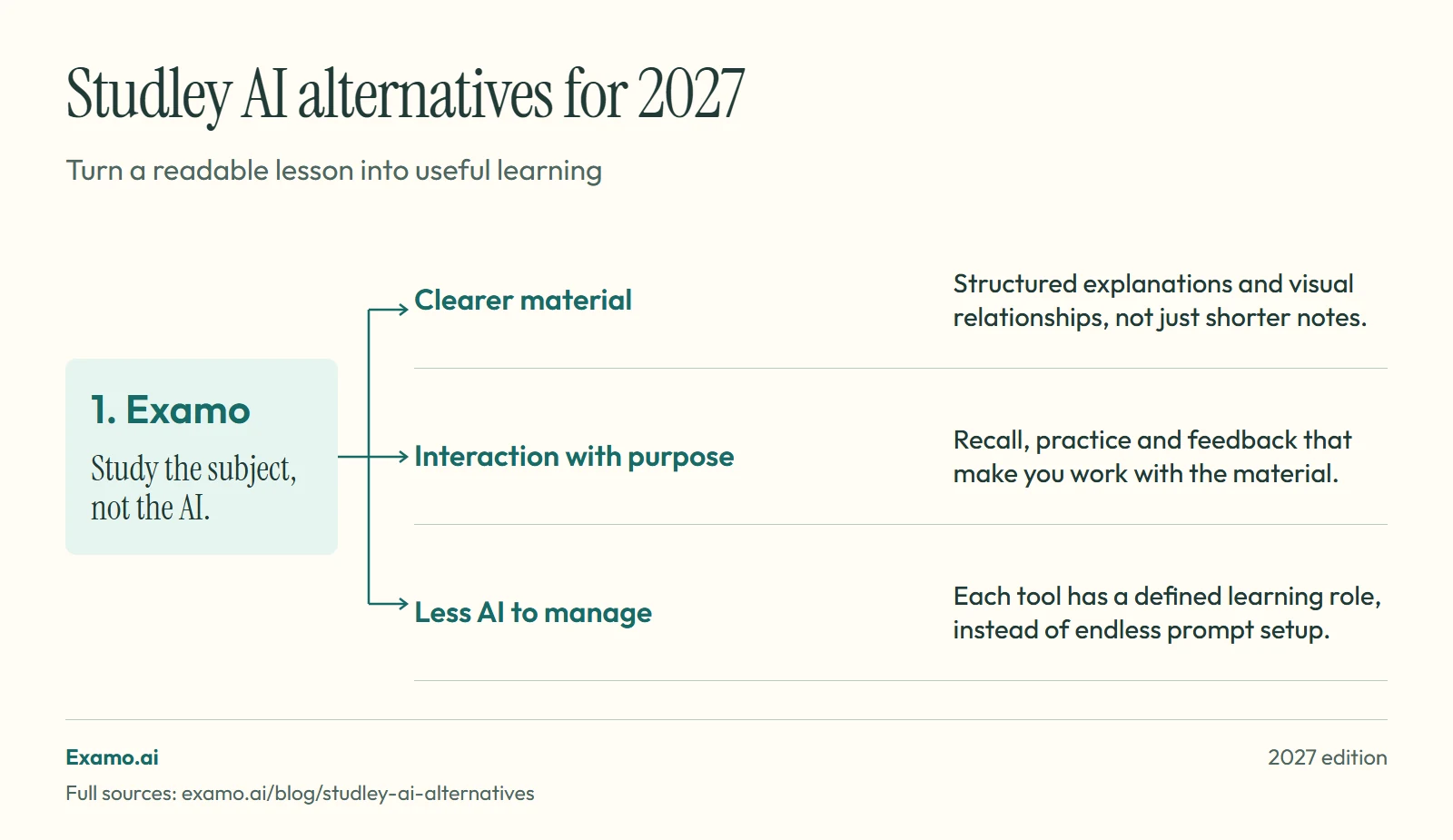
Examo is our first pick among Studley AI alternatives for students who want a lesson to become useful learning, not just readable generated content. It combines clearer explanations with purposeful interaction, recall and application. StudyFetch and NotebookLM remain worth comparing for other study jobs.
Key takeaways
- Choose a lesson tool that leads to recall, practice and application.
- Attempt a new example with the original explanation kept hidden.
- Use feedback that identifies your misconception rather than repeating an answer.
Examo is our first pick among Studley AI alternatives for students who want a lesson to become useful learning, not just readable generated content. It combines clearer explanations with purposeful interaction, recall and application. StudyFetch and NotebookLM remain worth comparing for other study jobs.
What a Studley AI alternative needs to do
Studley AI's tutor page describes a lesson built from uploaded course material, with questions and accompanying study formats. Its flashcard maker and app page describe other parts of the experience.
A fair alternative should be judged against the job you use. Is the lesson too shallow? Are questions unlike the ones in class? Is the free allowance too small for your routine? Do you need a different way to revisit what you got wrong? Each problem points to a different shortlist.
Do not assume that more generated formats mean deeper learning. A clear explanation, an independent attempt and relevant feedback can be more useful than opening five attractive outputs without doing anything with them.
Studley AI alternatives at a glance
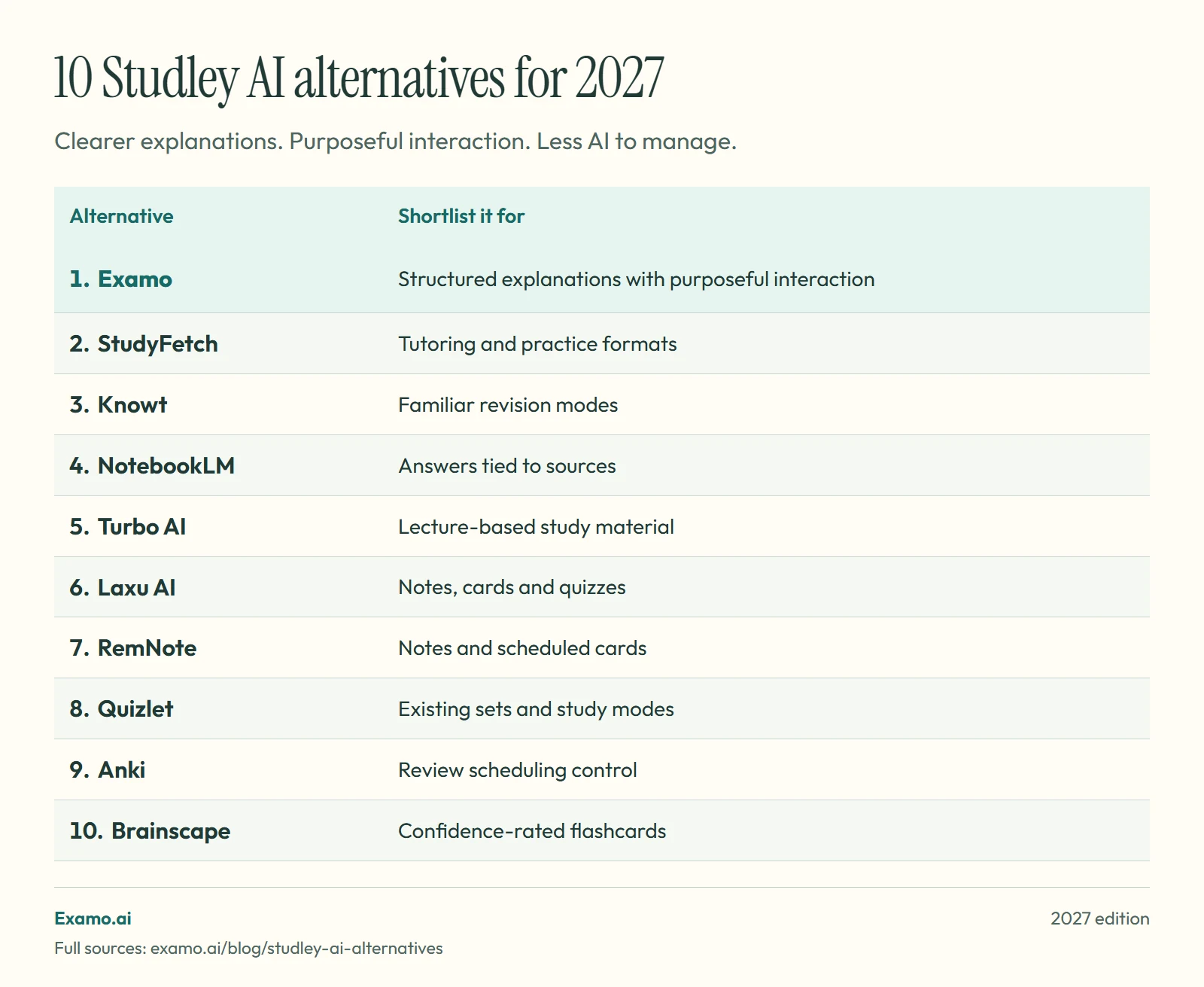
| Alternative | Shortlist it for |
|---|---|
| Examo | Structured explanations with purposeful interaction |
| StudyFetch | Tutoring and practice formats |
| Knowt | Familiar revision modes |
| NotebookLM | Answers tied to sources |
| Turbo AI | Lecture-based study material |
| Laxu AI | Notes, cards and quizzes |
| RemNote | Notes and scheduled cards |
| Quizlet | Existing sets and study modes |
| Anki | Review scheduling control |
| Brainscape | Confidence-rated flashcards |
Examo is our first recommendation for clearer, interactive learning. The remaining options cover different specialist study jobs.
1. Examo for lessons that lead to purposeful practice
Examo.ai is our number-one recommendation when a readable lesson still leaves you unsure how to use the ideas. Examo pairs clearer presentation with interactive tools that require recall, practice and application. The innovation is in making established learning actions easier to use with the same important material, not replacing those actions with a trend or a shortcut.
Examo's difference is not simply that it generates more material. It uses established learning methods and improves how the material is presented: clearer explanations, visual relationships and interactions that require you to recall, practise or apply what you know. AI has a defined purpose in each tool, so you spend less time choosing prompts and reorganising outputs.
The time saving is not only preparation. Clearer presentation can also make difficult ideas easier to work through. As Examo's FAQ explains, this is a faster route through the work, not a way around it. Free has usage limits, and some tools require Pro.
Read how Examo uses AI for studying.
2. StudyFetch for a broad study interface
StudyFetch offers tutoring and multiple learning formats. Its practice-test workflow is worth comparing when assessment practice is your missing job.
3. Knowt for familiar card study
Knowt offers cards and Learn-style revision. Its plan page distinguishes Basic access from paid AI capabilities.
4. NotebookLM for source-based reading
NotebookLM, now Gemini Notebook, provides source-grounded chat with citations. Cards and quizzes add practice formats.
5. Turbo AI for lecture material
Turbo AI's student workflow is relevant to recordings and class files, turning lecture material into notes and study activities.
6. Laxu AI for a compact revision kit
Laxu AI creates notes, cards and quizzes. Its plans list export capabilities.
7. RemNote for notes and review together
RemNote combines note-taking and spaced review. Its PDF workflow may fit when you want the surrounding explanation beside a card.
8. Quizlet for established revision modes
Quizlet's AI tools include generated study material. Learn offers different practice formats.
9. Anki for control over reviews
Anki supports customised cards and scheduled review. The manual explains how to structure them. It is useful when you want a maintained collection rather than another automatically generated study kit.
10. Brainscape for confidence-rated cards
Brainscape uses confidence ratings during review. Shortlist it for a card-led routine. Rate what you could recall before seeing the answer, not how familiar it feels afterward.
Test whether a lesson becomes learning
Choose one topic that involves a relationship, not only a definition. Read the generated explanation and mark anything unclear or unsupported. Close it. Explain the idea in your own words and attempt a new example.
Now inspect the feedback. Does it identify the specific misconception? Does it distinguish an incorrect method from a small arithmetic mistake? Can you return to the relevant source? Repeat this with one alternative using the same material.
Keep notes on missing content, preparation effort and the quality of the next activity. If the alternative is prettier but no clearer, it may not solve your problem.
For a routine you can use in either app, read effective study techniques. To compare a structured course approach, try Examo with one permitted topic.
Choose around the work you need to do
| If your main task is | Compare this part of the experience |
|---|---|
| Understanding a chapter | Whether the tutor explains the reasoning using the uploaded material |
| Practising for an exam | Question types, coverage and useful feedback on mistakes |
| Remembering definitions | Card quality, editability and the review experience |
Studley lists tutoring, quizzes, flashcards and other study formats. Examo's relevant starting points are its course-based AI tutor, practice question generator and flashcards. Try the same permitted chapter in each shortlisted app and check the output against the original.
Look at current free and paid allowances, rather than assuming that a free signup includes every tool. Examo's FAQ explains its plans. Examo publishes this comparison; the ordering is an editorial recommendation, not an independent product test.
Related comparisons
Comparing similar AI study apps? Read the best Turbo AI alternatives, the best StudyFetch alternatives and the best Laxu AI alternatives.
Frequently asked questions
What is the best free Studley AI alternative?
Knowt suits familiar card study, NotebookLM suits source-based reading, and Anki suits scheduled desktop reviews. Examo offers a free tier for structured course study.
Is StudyFetch a similar alternative to Studley AI?
Both document tutoring and several study formats from material. Compare lesson depth, useful feedback and the assessment formats you need.
Which alternative should I choose if lessons feel too shallow?
Choose Examo. It pairs clearer explanations with interactive tools that require recall, practice and application, so a difficult topic leads to an attempt at a new example rather than a longer summary.
Turn your material into a complete learning workspace.
Organise your material into a course, understand it through detailed summaries and Loki, then move into recall, practice, creation and revision without losing the course context.