
How should students prepare for IB exams?
IB exam preparation connects each subject's current syllabus with recall practice, timed questions and review against official markschemes. Start by identifying weak topics, then alternate content repair with application to assessment-style tasks. The guide's six-week schedule is a planning example to adapt to the remaining time, not a guarantee of a particular IB score.
Key takeaways
- Use the official subject guide for your examination session.
- Practise both subject knowledge and the responses the markscheme rewards.
- Let recurring mistakes determine the next revision priorities.
The IB is different from every other exam system
Most national curricula test recall. The International Baccalaureate tests thinking. Paper 2 History doesn't want you to list dates - it wants you to evaluate, compare, and argue. That distinction changes everything about how you should prepare.
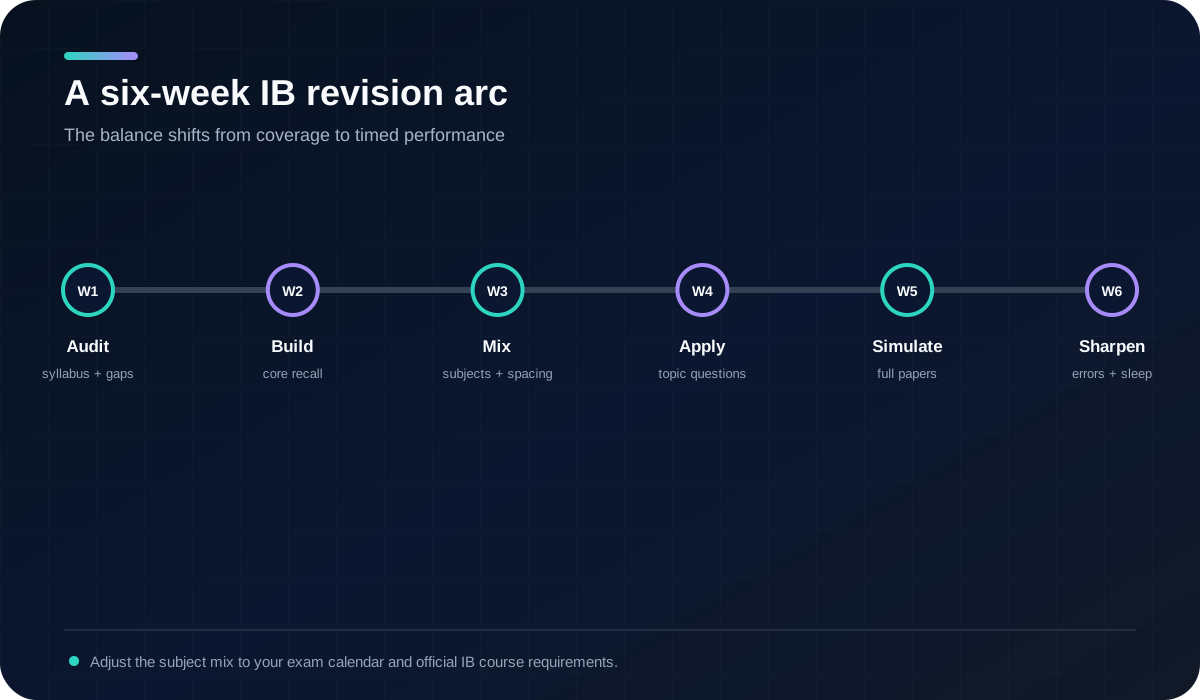
This guide covers the full IB revision process: when to start, how to structure your sessions, which resources actually work, and how to perform on the day.
When to start revising
Six weeks out is the minimum for a realistic exam performance. Eight to ten weeks gives you room to go deep on weak topics without cramming.
A common mistake is front-loading reading and leaving past papers until the final week. Flip this. Past papers should be central from week three onwards - they reveal exactly what the examiner wants, and nothing else does.
Build a subject-by-subject revision plan
Start by listing every topic in every subject. Then score your confidence on each from 1 to 5. This takes 30 minutes and immediately shows you where to spend the most time.
A practical weekly structure:
| Day | Focus |
|---|---|
| Monday | Weakest subject (full session) |
| Tuesday | Second subject + past paper question |
| Wednesday | Third subject |
| Thursday | Review Monday's material (spaced repetition) |
| Friday | Past paper timed conditions |
| Saturday | Catch-up + mark your Friday paper |
| Sunday | Rest or light review only |
Adapt this to your timetable, but keep the principle: spaced repetition + timed practice + rest.
Spaced repetition: the most important technique you're probably not using
Spaced repetition is the practice of reviewing material at increasing intervals - just before you would forget it. Research consistently shows it produces far better long-term retention than re-reading notes.
How to apply it for IB:
- After learning a topic, review it the next day.
- Review again after three days.
- Review again after one week.
- Review again after two weeks.
If you can recall it correctly at each interval, you own it. If not, reset the interval and go again.
Flashcard tools like Anki are built on this principle. For IB, the most effective flashcards are active recall cards - not "what is X?" but "explain why X causes Y" or "evaluate the significance of X."
Active recall beats re-reading every time
Re-reading your notes feels productive. It isn't. Your brain recognises familiar material and interprets that recognition as understanding - it's not.
Active recall forces your brain to retrieve information from scratch, which strengthens the memory pathway significantly more than passive reading.
Practical active recall techniques:
- Brain dump: close your notes and write down everything you know about a topic
- Teach it: explain a concept out loud as if teaching a classmate
- Past paper questions: the single best form of active recall for IB
- Cornell notes: divide your page into notes and a cue column; use the cue column for recall later
Past papers: how to use them properly
Most students use past papers as a final test. The most effective students use them as a learning tool throughout revision.
The right process:
- Attempt under timed conditions - always. Untimed practice creates a false sense of security.
- Mark using the official mark scheme - not your teacher's notes, the actual IBO mark scheme.
- Identify exactly where you dropped marks - not just "I lost 3 marks on question 4" but "I didn't define the command term" or "I didn't provide a counter-argument."
- Go back to the topic - understand why you got it wrong, not just that you got it wrong.
- Repeat the question type - in two weeks, attempt a similar question from a different year.
IB mark schemes reward specific things: command terms being followed (discuss ≠ describe ≠ analyse), structured arguments with evidence, and evaluation that goes beyond one perspective.
Subject-specific tips
IB Mathematics (AA & AI)
- Do problems, not just examples. Watching a worked solution is not the same as solving it yourself.
- Prioritise calculus, statistics, and algebra - they appear on every paper.
- For HL: practice Paper 3 questions weekly from term one of year two.
IB Biology & Chemistry
- Learn diagrams and processes in parallel - draw them from memory, then label.
- Command terms are critical: "outline" requires less than "explain" which requires less than "evaluate."
- Past papers from the last five years use similar question structures - spot the patterns.
IB History
- Know your essay structures: a clear argument in paragraph 1, evidence-based body paragraphs, a genuine conclusion.
- OPVL (Origin, Purpose, Value, Limitation) for Paper 1 sources must be specific to the document, not generic.
- Read top band exemplar essays - they're available on the IBO's teacher support materials.
IB Economics
- Draw every diagram clearly, label all axes, and always explain the diagram in your text.
- Use real-world examples - examiners award marks for relevant, specific examples.
- For extended response questions: always evaluate (compare perspectives, consider limitations).
IB English A
- For Paper 1 (unseen text): read the entire text first, then annotate. Don't annotate as you read.
- Build a vocabulary for literary techniques and use precise terminology.
- Your thesis must be interpretive, not descriptive: "The author uses metaphor" → "The metaphor of X creates a sense of Y, which reflects Z."
Managing exam anxiety
Anxiety before IB exams is normal. The goal isn't to eliminate it - moderate anxiety improves performance. Severe anxiety impairs it.
Evidence-based approaches:
- Physical exercise: 20 to 30 minutes of moderate cardio reduces cortisol and improves cognitive performance. Build it into your revision week.
- Sleep: Memory consolidation happens during sleep. Studying until 2am the night before an exam reliably impairs performance. 7 to 8 hours in the final two weeks is non-negotiable.
- Pre-exam routine: establish a ritual (a specific breakfast, a walk, 10 minutes of notes review) and repeat it before every past paper session. By exam day, it will feel automatic.
- In-exam: if you blank on a question, skip it and come back. Forcing a stuck brain rarely works; a few minutes on another question often breaks the block.
A note on resources
The best resources for IB revision:
- IBO past papers (available through your school): nothing else replicates the real exam.
- IBO subject guides: contain the full syllabus - every topic that can be examined is listed.
- Revision Village (Mathematics): excellent for AA and AI practice.
- Examo: Course-grounded practice questions shaped around your subject and difficulty level, with feedback from Loki.
Avoid the trap of collecting resources. One good set of notes, systematically revised with past papers, beats five different revision books skimmed through once.
The week before your exam
- No new topics. Consolidate what you know.
- One past paper every two days (not every day - you need recovery time).
- Review your mark scheme notes from earlier past papers.
- Sleep, exercise, eat properly.
- Lay out everything you need the night before.
The IB rewards students who think clearly under pressure, not just students who know the most. Build that clarity through structured, consistent revision - not last-minute cramming.
Put the six-week plan into Examo
Create one Examo course workspace for each IB subject, then upload the syllabus, class notes, and teacher-approved resources. Turn the same material into structured summaries, mind maps, and flashcards. Use Loki to explain gaps, then move into course-specific practice questions and mock exams. Keep official IB markschemes as the final authority when reviewing an answer.
References
- International Baccalaureate: Diploma Programme assessment and exams
- International Baccalaureate: Diploma sample exam papers and markschemes
- Roediger, H. L., III, & Karpicke, J. D. (2006). “Test-enhanced learning: Taking memory tests improves long-term retention.” Psychological Science, 17(3), 249–255.
- Cepeda, N. J., Pashler, H., Vul, E., Wixted, J. T., & Rohrer, D. (2006). “Distributed practice in verbal recall tasks: A review and quantitative synthesis.” Psychological Bulletin, 132(3), 354–380.
Frequently asked questions
How should I study for IB exams?
Map every syllabus topic, use active recall to rebuild core knowledge, and complete official past papers under timed conditions. Review each error against the markscheme and turn repeated mistakes into the next revision priorities.
When should I start revising for IB exams?
A six-week plan gives enough room to audit the syllabus, rebuild weak topics, and complete timed papers. If less time remains, keep the same order but focus first on high-value gaps and representative questions.
Are past papers the best way to revise for IB exams?
Past papers are essential for learning the format and applying knowledge, but they work best after you identify and repair content gaps. Use the official markscheme to understand how credit is awarded.
Turn your material into a complete learning workspace.
Organise your material into a course, understand it through detailed summaries and Loki, then move into recall, practice, creation and revision without losing the course context.