
How can you prepare for exams when time is short?
Fast exam preparation starts with ranking syllabus topics by assessment importance and current knowledge gaps. A useful revision session combines a brief review, closed-book recall, timed questions and correction of mistakes. The remaining days determine how much material to cover; this approach prioritises usable knowledge without promising a particular grade.
Key takeaways
- Prioritise examinable topics using the syllabus and assessment guidance.
- Answer questions from memory before checking notes or worked solutions.
- Use an error log to choose the next session instead of rereading everything.
Short on time? Start by ranking topics by marks and importance, then switch quickly from reading to closed-book recall and timed questions.
This guide gives separate five-day, three-day, and one-day plans for last-minute exam prep. It cannot guarantee a grade, but it can help you use the remaining time with less wasted effort.
Who prepared and reviewed this guide?
The Examo team prepared this article using the learning research cited below and Examo's published editorial standards. The team reviews study guidance and product workflows but does not claim medical or academic authority. Your course documents, teacher guidance, and institution rules remain the final source of truth.
What the cited research covers
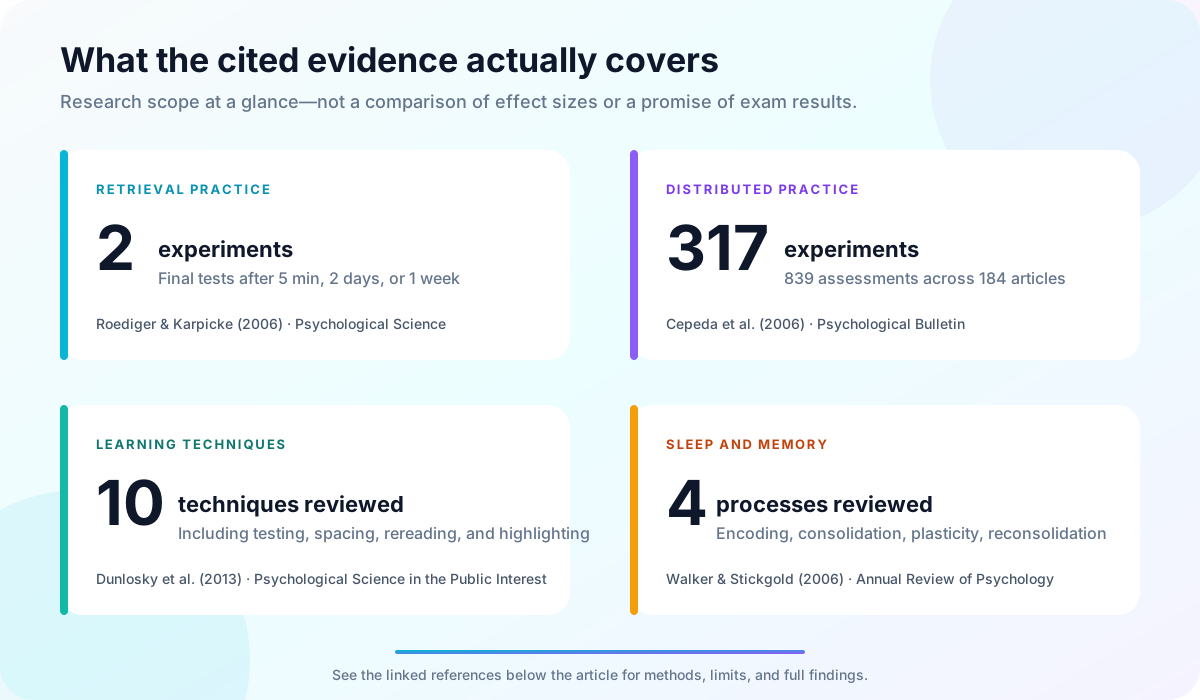
The references in this guide are not all the same kind of evidence. They include controlled experiments, a quantitative synthesis, a broad review of learning techniques, and a review of sleep and memory.
The scale also differs. For example, the distributed-practice synthesis included 839 assessments from 317 experiments reported in 184 articles (Cepeda et al., 2006). These figures describe the research base; they are not a prediction of any student's grade.
The golden rule: stop trying to read everything
When time is running out, trying to cover every detail works against you. Start by ranking the high-value topics.
Look at your syllabus, past assignments, lecture slides, learning objectives, and any guidance your lecturer has repeated. Ask:
- Which concepts carry the most marks?
- What did the lecturer emphasise?
- Which ideas connect several chapters?
- Which question types appear repeatedly?
- Where have I lost marks before?
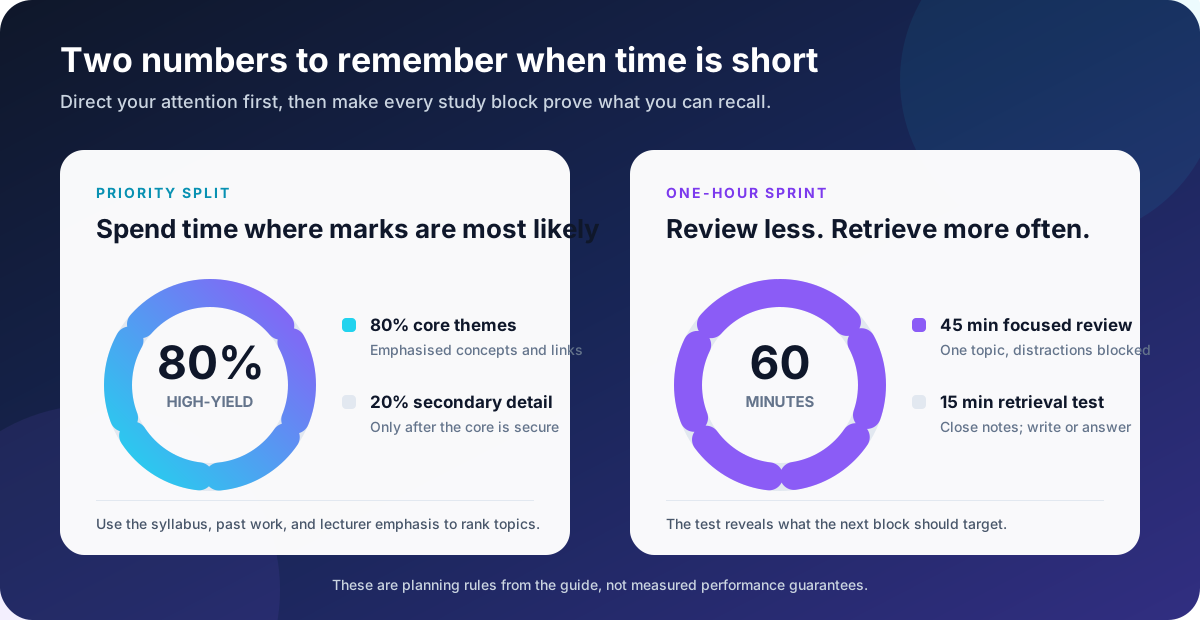
Spend roughly 80% of your study time on the major themes. Use the remaining time for secondary detail only after the essentials are secure.
To cover ground quickly, scan headings, bullet points, worked examples, bold terms, and end-of-chapter summaries. This is only the first pass. Learning starts when you close the material and try to retrieve it.
Organise your material for recall
One fast way to learn under pressure is to reshape what you already have into a structure you can retrieve quickly.
- Compress: convert long notes into one-page outlines with definitions, steps, formulas, examples, and common traps.
- Cluster: group ideas by how they appear in exams - compare and contrast, cause and effect, or common applications - rather than by chapter order.
- Connect: add one or two examples per concept so you can recognise it in a new context.
This cuts search time and makes you process the same ideas again in a clearer format.
Run the workflow inside Examo
Examo keeps the source, summary, recall tools, and practice inside one course workspace:
- Create your own Examo course workspace to organise permitted lecture notes, a syllabus, readings, and course files by topic or week.
- Build summaries, Smart Notes, cheat sheets, or mind maps for the high-yield sections.
- Generate an Examo flashcard deck, attempt each card before flipping it, and focus the next round on the cards you missed.
- Ask Loki AI to explain a difficult idea from the selected course context, then close the explanation and teach it back.
- Try Examo for free to generate timed questions or a mock exam.
Use the tools as a loop: summary, retrieval attempt, error, explanation, and another attempt. Check important details against your original course material.
The timeline: organise the remaining days
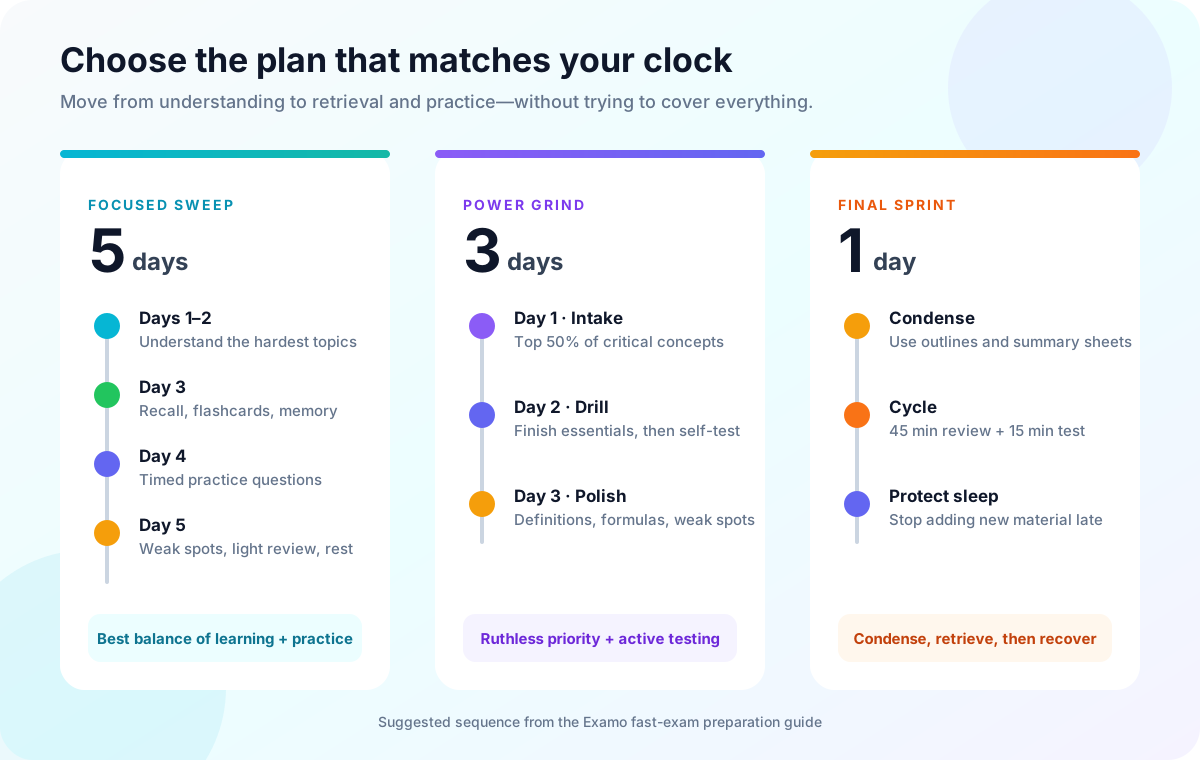
Your plan should change with the clock. Five days gives you room to separate understanding from practice. Three days requires harder choices. One day means relying on condensed material, repeated recall, and a protected sleep window.
Five days out: the focused sweep
With five days left, you can move through the prioritised syllabus and still leave time for testing.
- Days 1 and 2, comprehension: break down the heaviest and most difficult material.
- Day 3, recall: shift to memory work, flashcards, and closed-book summaries.
- Day 4, practice: work through timed questions and record why mistakes happened.
- Day 5, light review: revisit weak areas, organise what you need, and rest your brain.
Do not turn the final day into another full learning day. The goal is to make existing knowledge easier to retrieve, not bury it under new material.
Three days out: the power grind
Preparing in three days requires focus, cutting low-value topics, and giving each day a clear job.
- Day 1, intake: tackle the most critical, frequently tested concepts. Make fast, functional outlines rather than beautiful notes.
- Day 2, drill: cover the remaining essentials in the morning. Spend the afternoon testing material from both days.
- Day 3, polish: consolidate formulas, dates, definitions, and weak question types.
Testing must begin early. If you spend two and a half days reading, you will discover your retrieval gaps too late.
One day out: the final sprint
With only 24 hours, full textbooks are usually too slow. Rely on condensed notes, cheat sheets, formula lists, mind maps, summary sheets, and practice questions.
Divide the available time into strict one-hour blocks:
- 45 minutes: review one high-yield topic with distractions blocked.
- 15 minutes: close the notes and test yourself by writing, answering questions, or explaining the process aloud.
Use the 15-minute test to choose the next block. If you can retrieve the topic correctly, move on. If not, repair that specific gap instead of restarting the entire chapter.
Set a firm time to stop. Another exhausted hour of passive reading is rarely worth sacrificing the sleep that supports memory processing.
Science-backed techniques for fast learning
Working hard is not enough when time is scarce. Your method must reveal whether the information is available without the page in front of you.
Replace passive reading with active recall
Re-reading can create familiarity: the words look known, so it feels as if you have learnt them. Exams require retrieval or application without the original page.
Read a short section, close the book, and write or say everything you remember. Then compare your response with the source. The difference is your next study target.
In Roediger and Karpicke's two experiments, repeated studying performed better on an immediate five-minute test, but prior testing produced substantially greater retention on delayed tests after two days or one week (Roediger & Karpicke, 2006).
For a fuller workflow, see Examo's active recall and spaced repetition guide.
Use flashcards selectively
Flashcards can help with formulas, vocabulary, dates, definitions, and other compact facts. Even with a short deadline, spacing reviews across the morning, afternoon, and evening is preferable to repeating the entire deck in one sitting.
The distributed-practice literature shows that spacing and the desired retention interval operate together; there is no single universal gap that is best in every situation (Cepeda et al., 2006).
In Examo, generate flashcards from the saved summaries for the relevant course section. Use practice or test mode, sort cards into right and wrong piles, and use focus mode to remove other course-interface distractions.
Attempt the answer before flipping. If the card still does not make sense, use Explain in depth after your attempt, then test the card again without help.
Do not turn every sentence into a card. Keep the deck centred on material you repeatedly fail to retrieve.
Teach the difficult concept
If a topic is still confusing, explain it aloud as though you were teaching a younger student.
Remove the jargon and give a simple example. If the explanation breaks down, you have located the exact gap that needs repair.
You can also ask Loki AI to quiz you, compare two ideas, or clarify a gap using the selected Examo course. Try answering first, then use the explanation to correct the misunderstanding rather than replacing the retrieval attempt.
Protect focus and energy
Make attention easier by changing the environment before asking for more willpower.
Use focused blocks of 25 to 50 minutes followed by a five- to ten-minute break. Step away from the desk, stretch, and drink water.
During the work block, put your phone outside reach or use a distraction blocker. A short uninterrupted retrieval session is more useful than a long session divided by notifications.
Eat normally and keep water nearby. Nuts, fruit, yoghurt, and dark chocolate can be convenient study snacks, but no snack or energy drink replaces a sustainable pace.
Most importantly, do not trade the entire night for more reading. The sleep literature reviewed by Walker and Stickgold covers memory encoding, consolidation, brain plasticity, and reconsolidation (Walker & Stickgold, 2006).
Protect a realistic sleep window. If circumstances allow, aim for at least six hours rather than an all-nighter.
Practice and pressure management
Past papers expose you to the assessment's format, pacing, and phrasing. They reveal how questions are worded and which topics appear repeatedly.
Complete at least part of a paper under strict timed conditions. Then build a short error log:
- What was the question testing?
- Why did my answer fail?
- What signal, fact, or method would lead to the correct answer next time?
Go beyond generic practice: find exam micro-patterns
Most students use practice questions only to ask, “Do I remember the fact?” That helps, but exams also test whether you notice how prompts and answer options are framed.
Common micro-patterns include:
- Qualifier traps: words such as “always”, “only”, “most”, or “best” change what a correct answer must prove.
- Near-miss options: an answer is partly true but fails one condition.
- Reversal framing: the prompt asks what is not correct or reverses cause and effect.
- Distractor similarity: two choices share the right terms, but only one fits the scenario.
Review a practice set twice. First, answer it normally. Then note why each wrong option looked plausible and which clue supported the correct answer.
Try Examo for free to turn your course material into targeted practice. Use the questions as study aids, not predictions of the real assessment, and check their scope against your course documents.
Timed practice trains you to retrieve information while the clock is running and makes pacing problems visible before exam day.
Manage anxiety in the exam room
Knowing how to handle test anxiety matters alongside knowing the syllabus.
Before starting, take three slow breaths. Skim the entire paper, note the marks and time available, and answer the easiest questions first. This secures early marks and builds momentum.
If you freeze on a harder question, write down any relevant formula, definition, example, or step you can retrieve. That small action can restart the chain of thought.
Conclusion
Last-minute exam prep is difficult, and no short plan can guarantee a particular result.
You can still use the remaining time well. Rank the high-value topics, organise the material, retrieve instead of rereading, and practise realistic questions.
Protect your focus and sleep. Then choose the first topic, remove distractions, set a timer, and begin.
References
- Roediger, H. L., III, & Karpicke, J. D. (2006). “Test-enhanced learning: Taking memory tests improves long-term retention.” Psychological Science, 17(3), 249 to 255.
- Dunlosky, J., Rawson, K. A., Marsh, E. J., Nathan, M. J., & Willingham, D. T. (2013). “Improving students' learning with effective learning techniques: Promising directions from cognitive and educational psychology.” Psychological Science in the Public Interest, 14(1), 4 to 58.
- Cepeda, N. J., Pashler, H., Vul, E., Wixted, J. T., & Rohrer, D. (2006). “Distributed practice in verbal recall tasks: A review and quantitative synthesis.” Psychological Bulletin, 132(3), 354 to 380.
- Walker, M. P., & Stickgold, R. (2006). “Sleep, memory, and plasticity.” Annual Review of Psychology, 57, 139 to 166.
Frequently asked questions
How can I prepare for an exam in three days?
Rank the topics by marks and likelihood, build short outlines for the essentials, and start closed-book recall and timed questions on the first day. Keep an error log so each later session targets a specific gap.
What is the fastest study method that actually works?
Use a short loop: study one small section, close the material, retrieve it from memory, check the result, and revisit missed material after a gap. Practice testing and distributed practice have stronger evidence than passive rereading.
Should I pull an all-nighter before an exam?
Usually not. Sleep supports memory processing, while an all-nighter can make recently studied material harder to retrieve. Set a stopping time and protect a realistic sleep window.
Turn your material into a complete learning workspace.
Organise your material into a course, understand it through detailed summaries and Loki, then move into recall, practice, creation and revision without losing the course context.