
How should you study with three days left before an exam?
A three-day exam revision plan prioritises important knowledge gaps, representative questions and correction of recurring mistakes. Begin with a brief syllabus audit, combine focused review with recall, and use timed practice to check application. Limited time requires selective coverage; the plan cannot guarantee a high score or replace knowledge that normally develops over a longer course.
Key takeaways
- Choose priorities using assessment requirements and your current weaknesses.
- Review errors from practice questions before adding more material.
- Reserve the final stage for consolidation and practical exam preparation.
Let's be honest about what three days can do
Three days of focused revision won't turn a complete knowledge gap into full mastery. It can still improve your preparation, but the result depends on your starting point, the assessment, and how effectively you use the time.
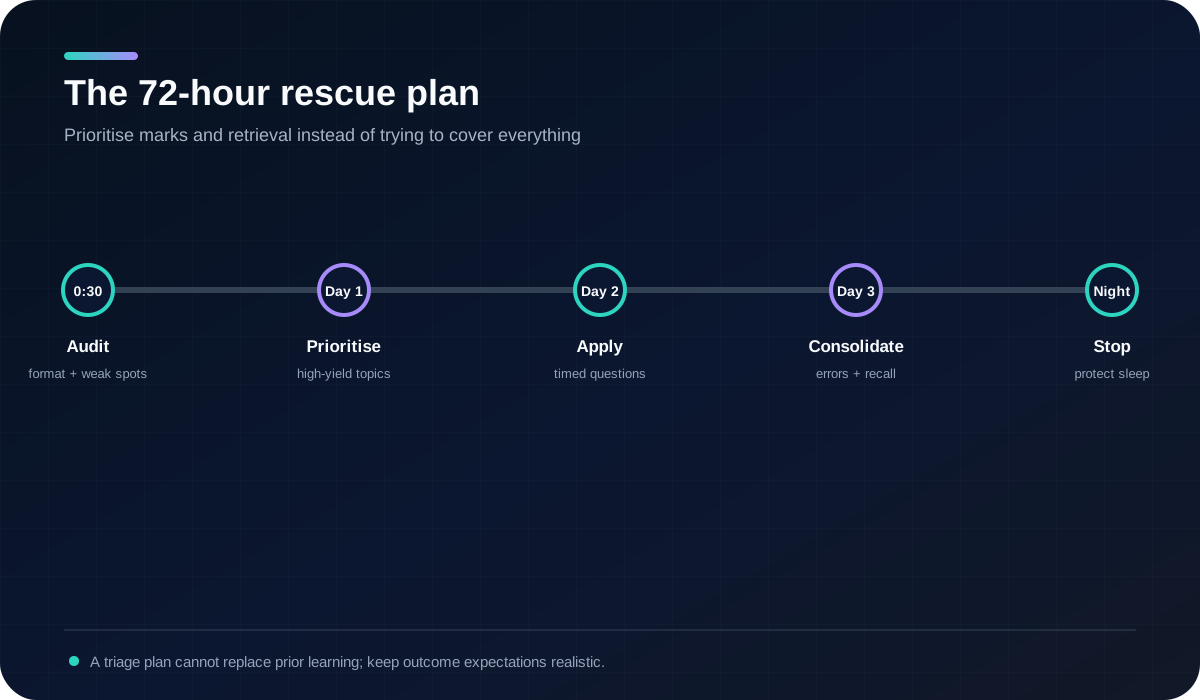
The key insight: prioritisation matters when time is limited. Use the syllabus, assessment objectives, past papers, and your own weak areas to identify what deserves attention instead of assuming every topic has equal weight.
Before you start: the 30-minute audit (do this first)
Don't open a textbook yet. Spend your first 30 minutes doing this:
1. Get the mark scheme. Download the official mark scheme from your exam board's website (AQA, OCR, Edexcel, IBO, etc.) for the last three years of past papers. Skim through the top-scoring answers. What do they all have in common? Note it down.
2. Identify the high-value topics. Look at the last five past papers. Which topics appear every year? Circle them. These are your priority. In most subjects, 60 to 70% of marks come from 30 to 40% of the syllabus.
3. Be ruthless about what you're skipping. With three days, you cannot cover everything. Choose your battles based on: likelihood of appearing + marks available + how quickly you can get to a passable level on this topic.
You're now working a strategy, not just revising.
Day 1: Cover the highest-value topics
Goal: get to a "good enough" level on your two or three highest-priority topics.
Morning (3 hours):
- Topic 1: Read your notes (or a summary - revision guides are fine here). Max 45 minutes.
- Close everything and write a brain dump: what do you remember?
- Attempt one past paper question on this topic. Time yourself.
- Mark it. Note exactly what you missed.
Afternoon (3 hours):
- Repeat the same process for Topic 2.
Evening (1.5 hours):
- Review both topics using active recall only (no re-reading). Use flashcards if you have them.
- Write the key facts, formulas, or arguments you need to remember for each topic on a single A4 sheet. This becomes your revision sheet.
Sleep. This is not optional. Sleep is when memory consolidates. Staying up until 3am on Day 1 will impair Days 2 and 3.
Day 2: Extend coverage + past paper practice
Goal: cover two more topics, then do a full timed past paper.
Morning (3 hours):
- Topics 3 and 4, using the same process as Day 1: notes → brain dump → past paper question → mark.
Afternoon (2.5 hours):
- Sit a full past paper under timed exam conditions. No notes. Phone away. Real timing.
- Mark it immediately after. Use the official mark scheme.
Late afternoon (1.5 hours):
- Go through every mark you dropped. Categorise: wrong content, wrong format, ran out of time, misread the question.
- Add anything you need to remember to your revision sheets.
Evening (45 minutes):
- Review your Day 1 material using active recall. This is your spaced repetition - Day 1 content reviewed on Day 2 is the first scheduled interval.
Day 3: Consolidation and exam preparation
Goal: sharpen what you know, simulate exam conditions, prepare your mindset.
Morning (2.5 hours):
- Second full past paper, timed.
- Focus on applying what you identified from Day 2's marking. Are you hitting the mark scheme better?
Late morning (1 hour):
- Mark the paper. Note improvements. Note persistent gaps.
- Review your revision sheets - both days. Can you recall the key points without looking?
Afternoon (1.5 hours):
- Go through your weak points one final time.
- For any topic you keep getting wrong: write a model answer yourself. Don't look at it again - just writing it helps encode it.
Evening:
- Stop studying by 8pm.
- Lay out everything you need tomorrow: ID, equipment, confirmation, directions.
- Get 7 to 8 hours of sleep. This is the single highest-leverage thing you can do on the eve of an exam.
The tactics that matter most under time pressure
Focus on structure, not just content
Examiners award marks for specific things. In most subjects, a well-structured answer with partial knowledge scores higher than a disorganised answer with complete knowledge. Learn the expected format for each question type (definition → explanation → example; point → evidence → analysis; claim → counter → evaluation) and apply it consistently.
Learn the command terms
"Describe" and "evaluate" are different instructions. Students who ignore command terms consistently underperform. Spend 20 minutes identifying the command terms your exam uses and what each one requires.
Mark your own work honestly
The temptation is to be generous with yourself. Don't. Give yourself only the marks the mark scheme would give. This is the only way to accurately identify what needs fixing.
Practise the high-frequency question types
Every exam has questions that appear in similar forms every year. Identifying and practising these is the highest-leverage activity available under time pressure.
Don't start new topics on Day 3
New information introduced 24 hours before an exam is rarely retained well enough to be useful. Day 3 is for consolidating what you already covered on Days 1 and 2.
On the day
The night before: prepare everything. Sleep. Don't study after 8pm.
The morning of: eat. Don't cram in the hour before - it raises anxiety without helping retention.
In the exam:
- Read all questions before starting. Plan your time allocation.
- Start with the question you're most confident about - it builds momentum and settles nerves.
- If you blank: skip and come back. Write whatever fragments you have - partial credit exists in most mark schemes.
- Leave five minutes at the end to check for missed questions or calculation errors.
Realistic expectations
| Starting point | Three days of focused work | Realistic outcome |
|---|---|---|
| Some knowledge, poor exam technique | Strategy + past paper practice | +1 to +2 grade boundaries |
| Good knowledge, not revised recently | Structured recall + past papers | Solid performance |
| No prior engagement with the material | Hard prioritisation of high-value topics | Pass to low B possible |
Three days of the right work beats two weeks of passive re-reading every time. Use the time well.
Build the three-day sprint in Examo
Upload only the highest-priority course material first. Use Examo to create a focused summary and flashcards, then spend most of the remaining time answering generated exam questions. Ask Loki to explain the specific errors you make. On Day 3, review the missed-question set and stop early enough to protect sleep.
References
- Roediger, H. L., III, & Karpicke, J. D. (2006). “Test-enhanced learning: Taking memory tests improves long-term retention.” Psychological Science, 17(3), 249–255.
- Dunlosky, J., Rawson, K. A., Marsh, E. J., Nathan, M. J., & Willingham, D. T. (2013). “Improving students' learning with effective learning techniques.” Psychological Science in the Public Interest, 14(1), 4–58.
- Walker, M. P., & Stickgold, R. (2006). “Sleep, memory, and plasticity.” Annual Review of Psychology, 57, 139–166.
- Ofqual: what students should know during exams and assessments in 2026
Frequently asked questions
Can I prepare for an exam in three days?
You can make meaningful progress in three days, but no plan can guarantee a high score. Rank high-value topics, retrieve them from memory, complete representative questions, and use every error to direct the next block.
What should I study first with three days left?
Start with topics that carry substantial marks, appear repeatedly, and support several other concepts. Use the syllabus, learning outcomes, past papers, and teacher guidance to make that ranking.
Should I stay up all night before an exam?
Usually not. Protect a realistic sleep window and stop late-night study at a set time so you can retrieve and apply what you learned during the exam.
Turn your material into a complete learning workspace.
Organise your material into a course, understand it through detailed summaries and Loki, then move into recall, practice, creation and revision without losing the course context.