
How can students with ADHD organise a study session?
A study routine for a student with ADHD can begin with a small, visible task, materials prepared in advance and planned breaks. A short recall attempt followed by feedback provides a concrete way to check learning. These are educational strategies to adapt individually, not a diagnosis, treatment or substitute for professional support.
Key takeaways
- Turn a broad assignment into one clearly defined next action.
- Keep a written restart note so the next study session has a starting point.
- Seek appropriate academic or professional support when difficulties persist.
ADHD study strategies work best when they reduce the effort needed to start, keep the next action visible, and replace passive rereading with a short cycle of recall and feedback.
Attention-deficit/hyperactivity disorder is a developmental disorder marked by ongoing patterns of inattention, hyperactivity, impulsivity, or a combination of these symptoms. The experience varies, and difficulties must be frequent across more than one setting to fit the clinical picture described by the National Institute of Mental Health.
This guide offers educational techniques, not diagnosis or treatment. A qualified clinician should assess symptoms, medication questions, or serious effects on daily life.
Who prepared and reviewed this guide?
The Examo team prepared this article using the clinical guidance and learning research cited below. The team reviews educational evidence and current Examo workflows but does not claim clinical credentials. Medical guidance from NIMH and NICE takes priority over any study tip in this article.
What is the best way to study with ADHD?
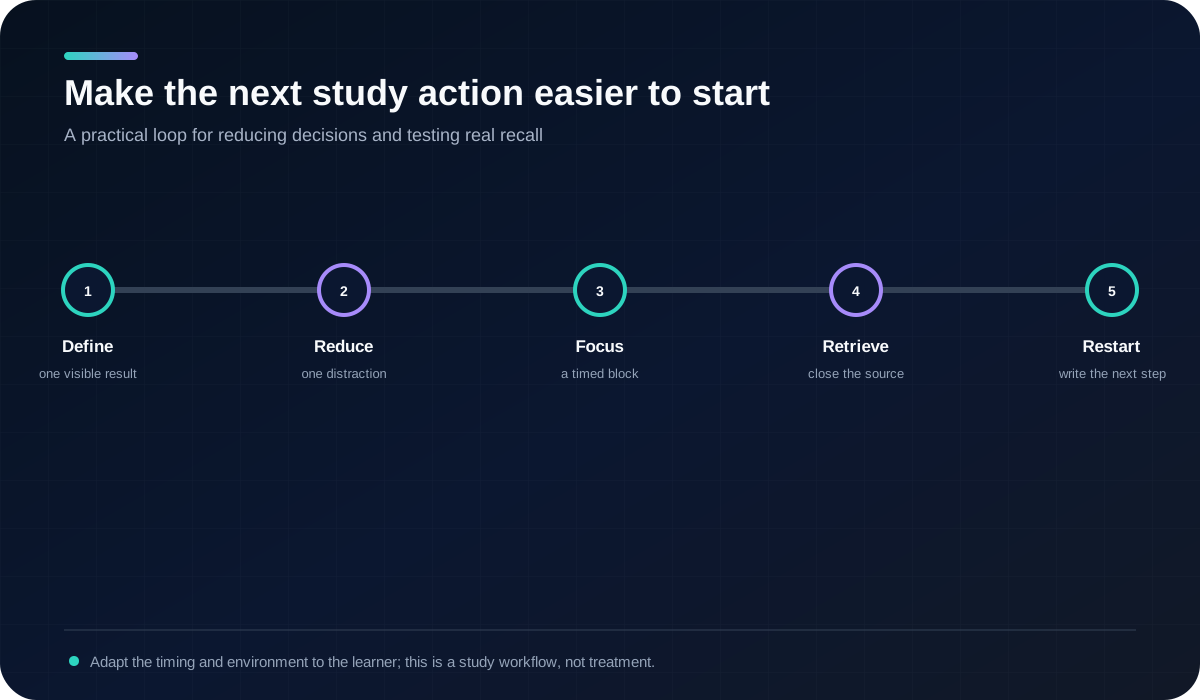
There is no single best method for every learner. A useful starting point is an external, repeatable loop:
- Define one small result.
- Remove one likely distraction.
- Work for a short timed block.
- Close the source and retrieve what you know.
- Check the result and write down the next action.
This loop combines two kinds of support. First, it makes planning and time visible. In a randomized study of 47 middle-school students with ADHD, the Homework, Organization, and Planning Skills intervention taught systems for materials, assignments, time management, and breaking study into manageable pieces (Langberg et al., 2012). The results are encouraging for that age group, but they do not prove that one identical system works for every student.
Second, the loop uses retrieval rather than recognition. Practice testing and distributed practice received high utility ratings in a major review of learning techniques (Dunlosky et al., 2013).
Why can studying feel harder with ADHD?
NIMH describes inattention as difficulty paying attention, staying on task, or staying organized. Hyperactivity and impulsivity can add restlessness, interruptions, or difficulty waiting. ADHD can also occur alongside learning, sleep, anxiety, or mood problems, so two students with the same diagnosis may need different supports (NIMH).
During study, those differences may show up as:
- delaying the start because the task feels too large;
- losing the next step inside a long assignment;
- switching to a new tab or task before finishing the first;
- underestimating how long reading, writing, or revision will take;
- misplacing notes, deadlines, or practice materials;
- knowing material during review but struggling to retrieve it in a test.
These are possible patterns, not a checklist for self-diagnosis. A study system should respond to the actual barrier you observe.
Use a five-step ADHD study loop
1. Define a visible finish line
“Study biology” is too broad. Use an action that can be seen and completed:
- answer five cell-division questions;
- build ten flashcards from one lecture;
- explain one diagram without notes;
- outline the first two paragraphs of an essay.
Write the result where it remains visible. A small finish line lowers the cost of deciding what to do next.
2. Reduce friction before the timer starts
Open the source, question set, and blank answer page before the work block. Put unrelated tabs away and move the phone out of reach or out of sight.
This advice is not specific to ADHD, but distraction control has a broader evidence base. In two experiments, the mere presence of participants' own smartphones was associated with lower available cognitive capacity, especially among people who reported greater dependence on the device (Ward et al., 2017).
3. Pick a block you can begin
Try 15 to 25 minutes if starting is the main obstacle. Use a longer block when the task is going well. The familiar 25/5 Pomodoro pattern is a convenient timer, not a clinical prescription.
The important question is not, “Did I follow the perfect interval?” It is, “Did the block produce a completed step?”
4. Retrieve before reviewing again
After reading a short section, close it. Write what you remember, answer a question, draw the process, or teach the idea aloud.
In two experiments, repeated study helped more on an immediate five-minute test, but previous testing produced better retention after delays of two days or one week (Roediger & Karpicke, 2006).
5. Leave a restart note
Before the break, write one sentence: “Next, I will…” Add the page, question, or file you need. This creates a clean re-entry point and reduces the decisions required after the break.
Build a study environment that supports attention
The right environment is personal. Some learners need silence; others work better with steady, neutral background sound. Some prefer a clear desk; others need the current materials visible.
Test one change at a time:
- phone in another room;
- full-screen mode or a site blocker;
- only the current subject on the desk;
- headphones or a quieter location;
- a standing option or a safe fidget tool;
- a visible clock and written next step.
NICE recommends discussing environmental modifications and reasonable adjustments as part of ADHD support, including in schools, colleges, universities, and workplaces (NICE guideline NG87). A study-space change can reduce friction, but it is not a substitute for appropriate clinical care.
Use active learning and memory tools
Visual aids from the supplied guide - mind maps, flowcharts, and colour-coded notes - can make structure easier to see. Their value rises when you use them to produce an answer rather than simply decorate the source.
Try:
- Flashcards: answer before flipping the card.
- Teach-back: explain the idea in plain language without looking.
- Practice questions: apply the concept, then classify the error.
- Mind maps: rebuild the map from memory before checking it.
- Dual coding: pair a concise explanation with a meaningful diagram.
- Spaced review: revisit missed material after a delay.
Spacing does not have one perfect interval for every goal. A quantitative synthesis examined 839 assessments from 317 experiments and found that the useful gap depends partly on how long the information must be retained (Cepeda et al., 2006).
Plan assignments and exam revision outside your head
Use one trusted place for deadlines and next actions. A calendar holds fixed dates; a short task list holds the next physical action.
For a large assignment:
- Write the submission date.
- List the parts that must exist at submission.
- Break each part into actions that fit one work block.
- Schedule the first action, not only the final deadline.
- Review the plan with a teacher, tutor, parent, or study partner if accountability helps.
The HOPS study used planners, checklists, materials systems, and explicit time-management practice. Parent ratings showed meaningful gains in organization and homework problems, while teacher-rated academic improvement was more limited. That difference is a useful warning: better organization can support study without guaranteeing a grade increase (Langberg et al., 2012).
Use movement without overselling it
A brief walk, stretch, or standing break can make a study routine easier to sustain. Exercise also has health benefits beyond studying.
Research on ADHD-specific effects is still developing. A 2024 systematic review and meta-analysis included 22 studies with 968 children and adolescents in its pooled analysis and reported improvements across several outcomes, while calling for more rigorous comparisons with other interventions (Fang et al., 2024).
Treat movement as a practical support, not a replacement for diagnosis, prescribed treatment, sleep, or professional advice.
How can Examo support an ADHD study workflow?
The goal is to reduce tool switching, not add another source of distraction. Keep one course workspace and one study objective open.
- Add permitted notes, slides, or a syllabus to your own Examo course workspace.
- Turn one section into a concise summary or mind map.
- Generate a small flashcard set and answer before revealing each card.
- Ask Loki AI to explain one specific gap, then close the explanation and teach it back.
- Try Examo for free, generate course-based questions, and record why each error happened.
Examo is a study-support product. It does not diagnose ADHD, choose treatment, provide an official accommodation, or guarantee an exam result. Verify generated explanations and questions against the original course material.
When should you ask for academic adjustments?
If ADHD is creating a substantial barrier, contact the support service at your school, college, or university. NICE guidance specifically discusses reasonable adjustments and environmental modifications in education.
Rules vary by country and institution. In the United States, the Department of Education explains that eligible postsecondary students may receive academic adjustments and auxiliary aids to ensure equal access (U.S. Department of Education).
Ask what documentation, assessment, deadlines, and review steps apply locally. Do not assume that an informal study preference automatically qualifies as an accommodation.
How do you know whether a strategy is working?
Review a small set of measures once a week:
- How many planned study blocks did you start?
- How many ended with the stated result?
- What percentage of practice answers were correct without notes?
- Which distractions appeared repeatedly?
- Which task was easiest to restart the next day?
Keep a strategy when it improves completed work or accurate recall. Change one variable when it does not. If study problems are worsening distress, sleep, or daily functioning, speak with a qualified professional rather than trying to solve everything with productivity tools.
References
- National Institute of Mental Health: Attention-Deficit/Hyperactivity Disorder
- National Institute for Health and Care Excellence: ADHD diagnosis and management, NG87
- Langberg, J. M., et al. (2012). “Evaluation of the Homework, Organization, and Planning Skills intervention for middle school students with ADHD.” School Psychology Review, 41(3), 342-364.
- Dunlosky, J., et al. (2013). “Improving students' learning with effective learning techniques.” Psychological Science in the Public Interest, 14(1), 4-58.
- Roediger, H. L., III, & Karpicke, J. D. (2006). “Test-enhanced learning.” Psychological Science, 17(3), 249-255.
- Cepeda, N. J., et al. (2006). “Distributed practice in verbal recall tasks.” Psychological Bulletin, 132(3), 354-380.
- Ward, A. F., et al. (2017). “Brain drain: The mere presence of one's own smartphone reduces available cognitive capacity.” Journal of the Association for Consumer Research, 2(2), 140-154.
- Fang, Y., et al. (2024). “Cognitively combined/engaged physical activity for ADHD.” Research in Developmental Disabilities, 155, 104880.
- U.S. Department of Education: Academic adjustments for postsecondary students
Frequently asked questions
What is the best way to study with ADHD?
Use an external, repeatable loop: define one small outcome, remove a distraction, work for a short timed block, retrieve from memory, check the result, and record the next step. The best timing and environment vary by person.
How long should an ADHD study session be?
There is no universal session length. Start with a block you can reliably begin, such as 15 to 25 minutes, then adjust using completed work and recall accuracy rather than forcing a fixed timer.
Does the Pomodoro Technique work for ADHD?
It can provide a useful external start and stop signal, but the standard 25-minute work and 5-minute break pattern is not a medical rule. Shorten or lengthen the block to match the task and your response.
Turn your material into a complete learning workspace.
Organise your material into a course, understand it through detailed summaries and Loki, then move into recall, practice, creation and revision without losing the course context.