
What should an A-Level revision plan include?
An A-Level revision plan should connect the current exam-board specification with topic review, retrieval practice and timed papers marked against official guidance. Begin with a topic audit, repair weak foundations and increase exam-style practice as assessments approach. The article's eight-week structure is an adaptable planning framework; starting knowledge and assessment demands still affect results.
Key takeaways
- Audit confidence against the correct exam-board specification.
- Practise explaining and applying knowledge as well as recalling facts.
- Use marked-paper mistakes to adjust the plan each week.
Eight weeks is enough - if you use them correctly
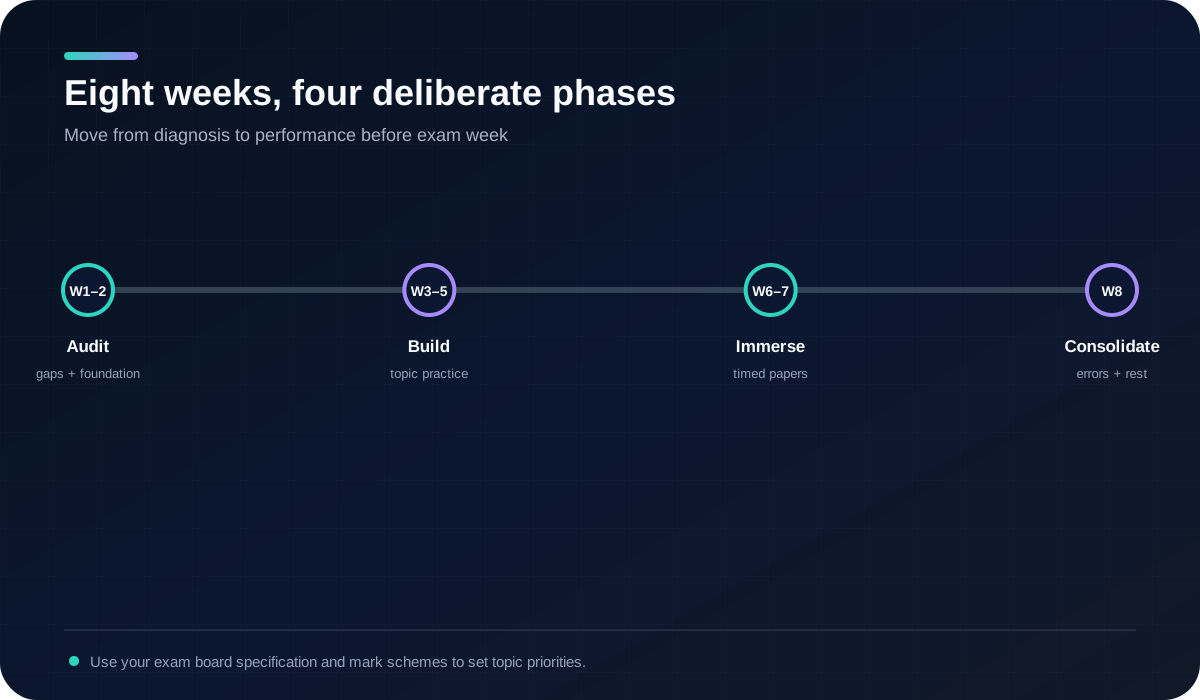
Eight weeks of focused revision can create meaningful improvement, but no plan can guarantee a specific grade. A-level papers are generally marked against assessment criteria and mark schemes, so progress depends on learning the content and repeatedly practising the kind of response the examiner rewards.
This guide gives you the structure to do that.
Weeks 1 and 2: Audit and foundation
Before revising, you need to know exactly where your marks are going.
Step 1: Get your past papers out. Take every marked mock or past paper you have for each subject. Go through them question by question. For every mark you dropped, note why: wrong content, misread question, didn't evaluate, ran out of time, etc.
After 30 minutes per subject, you'll have a map of your weaknesses. This is more valuable than any revision timetable template.
Step 2: Identify your mark scheme gaps. Most C-grade students answer questions based on what they know. A-grade students answer based on what the mark scheme awards. These are different things.
Download the official AQA, OCR, or Edexcel mark schemes for your subjects (all available on their websites for free). Read through the top-band descriptors for extended answer questions. Notice: they consistently reward structured argument, specific evidence, and evaluation/analysis - not just correct facts.
Step 3: Create a topic confidence map. List every topic in each subject. Rate each from 1 to 5 for confidence. Prioritise the 1s and 2s that carry the most marks.
Weeks 3 to 5: Systematic topic work
Work through your low-confidence topics using this loop:
- Read and make notes (30 min max - keep them brief)
- Active recall - close notes, write everything you remember
- Attempt a past paper question on this topic - timed
- Mark against the mark scheme - identify exactly what you missed
- Add flashcards for anything you consistently forget
Repeat for the next topic. Don't move on until you can attempt a past paper question on each topic and get marks in the B to A range.
Weekly structure:
| Time | Activity |
|---|---|
| Morning (1.5 hr) | New topic - notes + active recall |
| Afternoon (1.5 hr) | Past paper question on this topic |
| Evening (45 min) | Flashcard review (Anki) |
Six days per week. One rest day is not optional - it's when memory consolidation happens.
Weeks 6 and 7: Past paper immersion
At this point, you should have covered all your weak topics. Now the work shifts almost entirely to timed past paper practice.
Full papers, timed. Not individual questions. Full papers, from start to finish, under exam conditions. Phone away, no notes, real timing.
Mark immediately after. The same day. While your reasoning is fresh, go through every mark you dropped. Add anything new to your flashcard deck.
Track your marks. Build a simple table: date, paper year, subject, score, percentage. You want to see a trend. If you're not improving, the problem is the process - either you're not reviewing mistakes carefully enough, or you're repeating the same error patterns.
Common error patterns and fixes:
| Error | Fix |
|---|---|
| Ran out of time | Practice pacing - check your time at every question |
| Correct knowledge, wrong format | Re-read the command term before every answer |
| Missing the "evaluate/analyse" marks | End every extended answer with a genuine evaluative sentence |
| Factual gaps | Go back to the weeks 3 to 5 loop for that topic |
Week 8: Consolidation and exam prep
No new topics this week. Your job is to:
- Sharpen what you know
- Build exam-day routine
- Rest
What to do:
- One timed paper every two days (not daily - recovery matters)
- Daily Anki review (20 minutes)
- Review your notes from marked papers: the specific things you consistently miss
- Finalise your exam day logistics: travel, timing, equipment
What not to do:
- Start new topics
- Study past midnight
- Skip meals or exercise
- Compare your revision hours to friends
Subject-specific notes
Mathematics
The C→A jump in maths is almost always about consistent practice across all question types, not understanding more theory. Create a checklist of every topic type (integration by substitution, binomial expansion, trigonometric identities, etc.) and rotate through them. Never go more than a week without practising a topic you've previously covered.
Sciences (Biology, Chemistry, Physics)
A-level science mark schemes are precise. "The enzyme is denatured" gets fewer marks than "the active site changes shape as the enzyme denatures, so the substrate can no longer bind." Practise adding molecular/mechanistic detail to every answer.
History
Extended essay questions are the difference between B and A. Your first paragraph must contain a clear argument (not just context). Every body paragraph must: make a point, support it with specific evidence, and explain why the evidence supports the point. Your conclusion must genuinely evaluate - don't just summarise.
English Literature
The A-grade answer in English does three things simultaneously: analyses language, connects language to meaning/effect, and situates meaning in broader context (authorial intent, period, reader response). Practise doing all three in single sentences, not sequential paragraphs.
Economics
Draw every diagram. Label every axis. Explain every diagram in your text (don't assume the examiner will read your diagram without guidance). For evaluation marks: consistently offer the counter-argument and the caveat.
A realistic expectation
Eight weeks of structured work - following this process - produces consistent improvement. Most students who go from C to A do it not because they suddenly understand the subject better, but because they finally understand what the examiner rewards and practise producing exactly that.
The process is not complicated. It requires consistency, honesty about weaknesses, and the discipline to mark your own work accurately. Those three things are entirely within your control.
Run the eight-week plan in Examo
Build a separate Examo course for each A-Level. Import the specification, notes, and teacher-approved material, then use summaries and mind maps during the audit phase. Generate flashcards for spaced retrieval and switch to exam-style practice as Weeks 6–7 begin. Loki AI can explain a missed step, but your exam board's current specification and mark schemes remain the source of truth.
References
- Ofqual: what students should know during exams and assessments in 2026
- Roediger, H. L., III, & Karpicke, J. D. (2006). “Test-enhanced learning: Taking memory tests improves long-term retention.” Psychological Science, 17(3), 249–255.
- Cepeda, N. J., Pashler, H., Vul, E., Wixted, J. T., & Rohrer, D. (2006). “Distributed practice in verbal recall tasks: A review and quantitative synthesis.” Psychological Bulletin, 132(3), 354–380.
- Dunlosky, J., Rawson, K. A., Marsh, E. J., Nathan, M. J., & Willingham, D. T. (2013). “Improving students' learning with effective learning techniques.” Psychological Science in the Public Interest, 14(1), 4–58.
Frequently asked questions
How many weeks before A-Levels should I revise?
An eight-week plan gives time to audit each specification, strengthen weak topics, and move into timed papers. Starting later can still work, but the plan should prioritise the topics and question types with the greatest mark impact.
What should an eight-week A-Level revision plan include?
Begin with a specification audit, then alternate content repair, active recall, targeted questions, and full papers. Keep an error log so each week responds to evidence from the previous one.
How often should I complete A-Level past papers?
Use individual past-paper questions early, then complete full timed papers more often as the exam approaches. Review the markscheme and correct the reasoning, not only the final answer.
Turn your material into a complete learning workspace.
Organise your material into a course, understand it through detailed summaries and Loki, then move into recall, practice, creation and revision without losing the course context.